
- I-Learn, Class Pictures, Learning Targets, Text Book Practice
- Prep Tasks: Unit 1 - Motion, Unit 2 - Derivatives, Unit 3 - Integration, Unit 4 - Vector Calculus
This is day 8 of Unit 4.
Brain Gains (Rapid Recall, Jivin' Generation)
- Let $R$ be the region in space that lies inside the square with $-2\leq x\leq 2$ and $-2\leq y\leq 2$ and outside the circle $x^2+y^2=1$. Let $C_1$ be the curve that wraps around the square in a counter-clockwise fashion. Let $C_2$ be the curve that wraps around the circle in a counter-clockwise fashion. Let $\vec F (x,y) = \frac{(-y,x)}{x^2+y^2}$. Note that $\vec F$ is not defined at $(0,0)$.
- Draw the region $R$ and curves $C_1$ and $C_2$. Is the region $R$ simply connected?
- Show that $N_x-M_y=0$ for $(x,y)\neq 0$.
- Let $D$ be the disc inside $C_2$. Why can we not use Green's theorem to compute $\ds\int_{C_2}Mdx+Ndy$ using $\iint_D N_x-M_ydA$?
- Compute $\ds\int_{C_2}Mdx+Ndy$ directly.
- Green's theorem states that $\ds\iint_R N_x-M_y dA = \int_{\partial R}Mdx+Ndy$, provided that $\vec F$ is continuously differentiable along all of the region $R$, and all curves in the boundary $\partial R$ are oriented so that the region $R$ is on the left. Use Green's theorem to explain why $\ds\int_{C_1}Mdx+Ndy = \int_{C_2}Mdx+Ndy$.
- Let $C_3$ be any simple closed piecewise smooth curve which does not pass through the origin, but has the origin in the interior. Explain why $\ds\int_{C_3}Mdx+Ndy = 2\pi$.
Solutions
I'll let you draw the square and circle. The region is not simply connected as a loop that wraps around once cannot be be contracted to a point without leaving the region.
We compute $$\begin{align*} N_x - M_y &= \frac{\partial}{\partial x}(\frac{y}{x^2+y^2}) - \frac{\partial}{\partial y}(\frac{x}{x^2+y^2}) \\ &= \frac{(x^2+y^2)(0)-(-y)(2x)}{(x^2+y^2)^2} - \frac{(x^2+y^2)(0)-(x)(2y)}{(x^2+y^2)^2} \\ &= 0. \end{align*}$$
Note that $\vec F$ is not defined at $(0,0)$, let alone differentiable there. We can't employ Green's theorem, as we would have to integrate $N_x-M_y$ over a region $D$ where $N_x-M_y$ is undefined. The region $R$ conveniently dodges the origin, but has two curves that make up its boundary.
We are on a circle of radius 1, so we know that $x^2+y^2=1$ and hence $F = (-y,x)$ when on this circle. Using the parametrization $\vec r(t) = (\cos t, \sin t)$ for $0\leq t\leq 2\pi$, we have $$\begin{align*} \int_{C_2}Mdx+Ndy &= \int_{C_2} (-y)dx+xdy \\ &= \int_{0}^{2\pi} (-(\sin t))(-\sin t)+(\cos t)(\cos t)dt \\ &= \int_{0}^{2\pi} 1 dt \\ &= 2\pi. \end{align*}$$
Because $N_x-M_y=0$ inside all of the region $R$ (the region $R$ does not contain $(0,0)$), we have that $$\ds\iint_R N_x-M_y dA = \int_{\partial R}Mdx+Ndy.$$ The boundary $\partial R$ consists of the two curves $C_1$ and $C_2$, but to make sure the region $R$ stays on the left side of each curve, we must traverse $C_2$ in a clockwise fashion. This gives $$\ds\iint_R N_x-M_y dA = [\int_{C_1}Mdx+Ndy] + [-\int_{C_2}Mdx+Ndy]. $$ Because $N_x-M_y=0$, then we have $$0 = [\int_{C_1}Mdx+Ndy] + [-\int_{C_2}Mdx+Ndy]. $$ We can rearrange the above to obtain $\int_{C_1}Mdx+Ndy = \int_{C_2}Mdx+Ndy.$
Let $C$ be any circle centered at the origin. The same argument above will show that $\int_{C}Mdx+Ndy = \int_{C_2}Mdx+Ndy=2\pi$. Now let $C_3$ be a simple closed piecewise smooth curve that does not pass through the origin but contains the origin in its interior. Pick a curve $C_4$ that is a circle centered around the origin with a radius small enough that the entire curve $C_4$ lies inside $C_3$. Then let $R$ be the region between $C_3$ and $C_4$. Because $N_x-M_y = 0$, Green's theorem again gives $0 = [\int_{C_3}Mdx+Ndy] + [-\int_{C_4}Mdx+Ndy],$ and because $\int_{C_4}Mdx+Ndy=2\pi$, we have $\int_{C_3}Mdx+Ndy]=2\pi$.
Carefully choosing a region $R$ on which $N_x-M_y=0$ was crucial to all the work above. We had to dodge the place where $\vec F$ was undefined. Stokes' theorem and the divergence theorem have similar parallels to this problem, and picking a region where the curl or divergence of a vector field are zero will let you swap out one region for another.
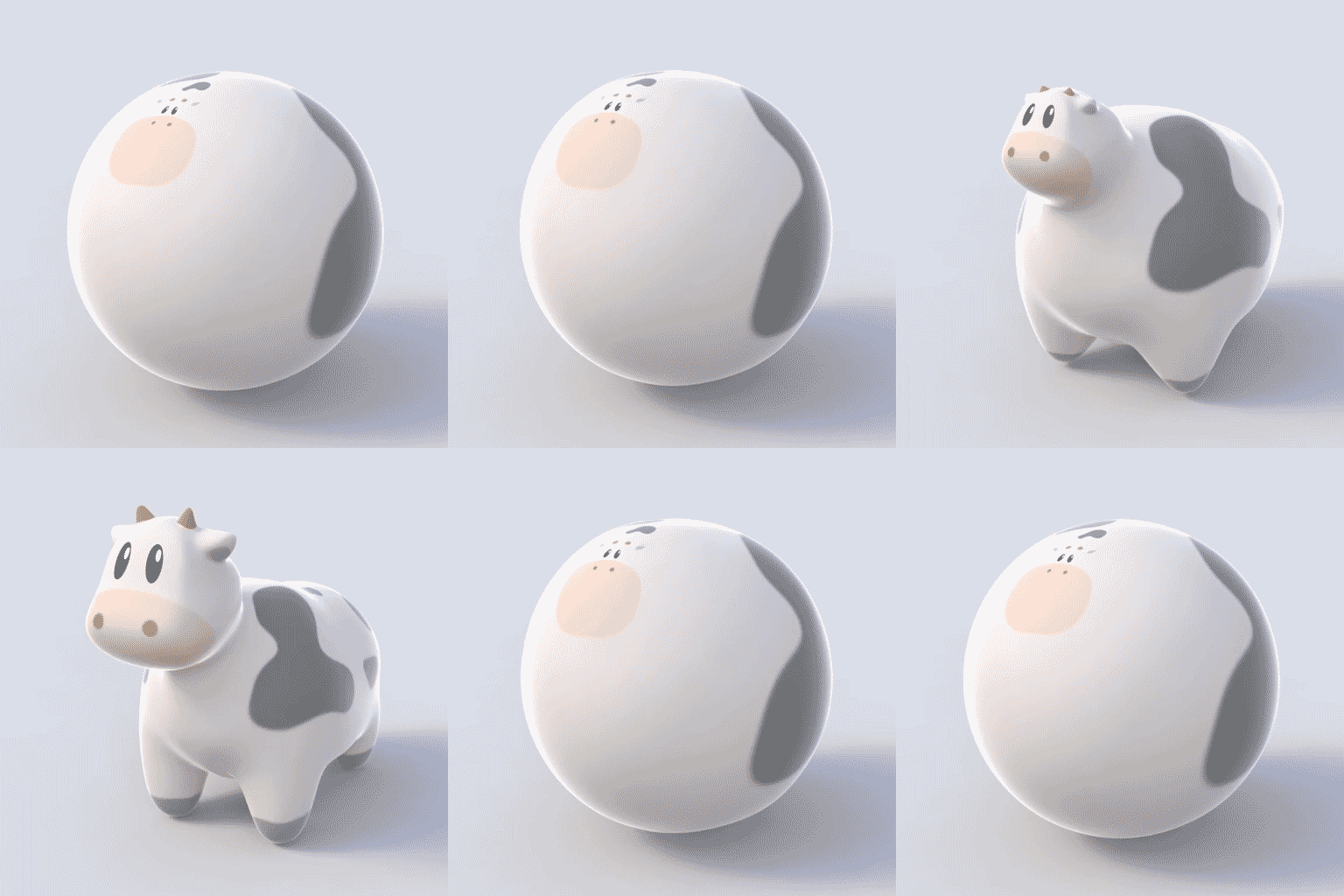
If we're lucky, we can assume a spherical cow (see https://en.wikipedia.org/wiki/Spherical_cow).
- The top half of the surface $S$ of a donut (a torus) can be parametrized by $\vec r(u,v) = ((5 - 3 \cos u) \cos v, (5 - 3 \cos u) \sin v, 3 \sin u)$ for $0\leq u\leq \pi$ and $0\leq v\leq 2\pi$. Imagine that someone puts icing on the top of this donut (so creates a surface), but the thickness of the icing is more on the top of the donut than on the sides. While not a perfect way to model this situation, we could use $\delta = kz$ for some constant $k$ as a way to model the surface with varying density. Set up an integral to compute the $z$-coordinate of the center-of-mass of the surface $S$ with density function $\delta = kz$. Note that after quite a bit of computation, we can obtain $|\vec r_u\times \vec r_v| = 3 \sqrt{(5-3 \cos u)^2}$.
Solution
We compute $$\bar z = \frac{\iint_S z \delta dS}{\iint_S \delta dS} = \frac{\int_{0}^{\pi}\int_{0}^{2\pi} (3 \sin u) (k 3 \sin u)3 \sqrt{(5-3 \cos u)^2}dvdu}{\int_{0}^{\pi}\int_{0}^{2\pi} (k 3 \sin u) 3 \sqrt{(5-3 \cos u)^2}dvdu} .$$ The following Mathematica code will compute all related quantities.
ClearAll[r, u, v, uB, vB, n]
r[u_, v_] := {(5 - 3 Cos[u]) Cos[v], (5 - 3 Cos[u]) Sin[v], 3 Sin[u]};
uB = {u, 0, Pi};
vB = {v, 0, 2 Pi};
n = Cross[D[r[u, v], u], D[r[u, v], v]];
Norm[n] // ComplexExpand // TrigReduce // FullSimplify
ParametricPlot3D[r[u, v], uB, vB]
Integrate[(z k z Norm[n]) /. z -> (3 Sin[u]), uB, vB]/Integrate[(k z Norm[n]) /. z -> (3 Sin[u]), uB, vB]
Given a solid domain $D$ with piecewise smooth boundary $\partial D$, where each portion of the boundary is a surface oriented pointing outwards away from $D$, then the integral of the divergence of $\vec F=(M,N,P)$ along $D$ is equal to the outward flux of $\vec F$ across the boundary $\partial D$, which we can write as $$\iiint_D \vec \nabla \cdot \vec F dV = \iint_{\partial D}\vec F\cdot\hat n dS.$$
- Note that $\partial D$ might consist of multiple surfaces. Sum $\iint_{S}\vec F\cdot\hat n dS$ for each surface $S$ that is part of the boundary to compute $\iint_{\partial D}\vec F\cdot\hat n dS$.
- For every surface $S$ that is part of the boundary, remember to make sure $\hat n$ is the outward pointing unit vector, pointing away from the solid domain $D$.
- Consider the vector field $\vec F = (x,x-z,y+z)$, the solid domain $D$ that lies inside the sphere $x^2+y^2+z^2=25$, and the surface $S$ parametrized by $\vec r(u,v)=(5\sin v\cos u, 5 \sin v \sin u, 5 \cos v)$ for $0\leq u\leq 2\pi$ and $0\leq v\leq \pi$.
- Draw the surface $S$ and domain $D$. How are these two objects related?
- We can compute $\vec N = \vec r_u\times \vec r_v = (-25 \cos u \sin ^2 v,-25 \sin u \sin ^2 v,-25 \sin v \cos v)$. Determine if $\vec N$ points inward toward the domain $D$ or outwards away from the domain $D$.
- Set up $\ds \iint_S \vec F\cdot \hat n dS$ for $\hat n$ pointing outwards, away from the solid inside $S$. This computes the outward flux of $\vec F$ across $S$.
- Set up and compute $\ds \iiint_D \vec \nabla \cdot \vec F dV$, the triple integral of the divergence of $\vec F$ over the domain $D$.
Solution
We are on a sphere. As such, at the point $(x,y,z)$ one option for a normal vector is $(x,y,z)$ (point straight out from where you are at), while another is $(-x,-y,-z)$ (point straight back towards the origin). Note that on the surface, we have $x = 5\sin v\cos u$ while the $x$-component of $\vec N$ is $-25 \cos u \sin ^2 v =-5x\sin v$. Because $x$ and $-5x\sin v$ will always have opposite sign, this means that $\vec N$ points inwards. To compute outwards flux, we must multiply $\vec N$ by a negative.
The code below computes the normal vector n, and computes both the flux and triple integral of the divergence.
ClearAll[F, r, uB, vB, n]
F = {x^2, 2 y, x + y + z};
r = {5 Cos [u] Sin[v], 5 Sin[u] Sin[v], 5 Cos[v]};
uB = {u, 0, 2 Pi};
vB = {v, 0, Pi};
ParametricPlot3D[r, uB, vB]

n = Cross[D[r, u], D[r, v]] // Simplify

Integrate[F . (-n) /. {x -> r[[1]], y -> r[[2]], z -> r[[3]]}, uB, vB]

Div[F, {x, y, z}]

(*For spherical coordinates, remember we need the Jacobian.*)
Integrate[(3 + 2 rho Cos[theta] Sin[phi]) rho^2 Sin[phi], {rho, 0, 5}, {theta, 0, 2 Pi}, {phi, 0, Pi}]
This chunk of code shows the vector field at points along the surface, so we can visually see that the outward flux is positive.
surface = ParametricRegion[r, Evaluate[{uB, vB}]];
SliceVectorPlot3D[F, surface, {x, -5, 5}, {y, -5, 5}, {z, -5, 5}]
SliceVectorPlot3D[F, surface, {x, -5, 5}, {y, -5, 5}, {z, -5, 5}, VectorScaling -> Automatic, VectorSizes -> Automatic]
Group Problems
- Consider the vector field $\vec F = (-2y,3x,z^2+5z)$, the solid domain $D$ that lies inside the sphere $x^2+y^2+z^2=4$, and the surface $S$ parametrized by $\vec r(u,v)=(2\sin u\cos v, 2 \sin u \sin v, 2 \cos u)$ for $0\leq u\leq \pi$ and $0\leq v\leq 2\pi$.
- Draw the surface $S$ and domain $D$. How are these two objects related?
- Compute $\vec N = \vec r_u\times \vec r_v$ and determine if $\vec N$ points inward toward the domain $D$ or outwards away from the domain $D$.
- Set up and compute $\ds \iint_S \vec F\cdot \hat n dS$ for $\hat n$ pointing outwards, away from the solid inside $S$. This computes the outward flux of $\vec F$ across $S$.
- Set up and compute $\ds \iiint_D \vec \nabla \cdot \vec F dV$, the triple integral of the divergence of $\vec F$ over the domain $D$.
- Consider the vector field $\ds \vec F = \frac{1}{2\pi}\left(\frac{-y}{x^2+y^2},\frac{x}{x^2+y^2}\right)$.
- Let $C$ be the curve parametrized by $\vec r(t) = (3\cos t, 3\sin t)$ for $0\leq t\leq 2\pi$. Compute the work done by $\vec F$ to move an object along $C$. [Hint: The answer is NOT zero.]
- Let $C$ be the curve parametrized by $\vec r(t) = (7\cos t, 7\sin t)$ for $0\leq t\leq 4\pi$. Compute the work done by $\vec F$ to move an object along $C$.
- Let $C$ be the curve parametrized by $\vec r(t) = (a\cos t, a\sin t)$ for $0\leq t\leq 2k\pi$. Compute the work done by $\vec F$ to move an object along $C$.
- Show that $D\vec F(x,y)$ is symmetric.
- Does $\vec F$ have a potential?
Solutions
If $\vec F$ had a potential, then the work done along a closed curve would be zero. This is not true, as the first 3 parts illustrate. The vector field does NOT have a potential.
The function and derivative are not defined at $(0,0)$, which means the domain of the vector field is not simply connected. We cannot use the symmetry of the derivative to conclude that there is a potential, because the domain is not simply connected.
Here are some Mathematica computations relevant to this problem.
ClearAll[F, r]
F[x_, y_] := 1/(2 Pi (x^2 + y^2)) {-y, x}
r[t_] := {a Cos[t], a Sin[t]}

(*Is the derivative symmetric*)
D[F[x, y], {{x, y}}] // Simplify // MatrixForm

(*Try to find a potential*)
Integrate[F[x, y][[1]], x]
Integrate[F[x, y][[2]], y]

(*Compute work done by wrapping k times around a circle of radius a*)
Dot[F @@ r@t, D[r[t], t]] // Simplify
Integrate[Dot[F @@ r@t, D[r[t], t]], {t, 0, 2 k Pi}]
|
Sun |
Mon |
Tue |
Wed |
Thu |
Fri |
Sat |