
- I-Learn, Class Pictures, Learning Targets, Text Book Practice
- Prep Tasks: Unit 1 - Motion, Unit 2 - Derivatives, Unit 3 - Integration, Unit 4 - Vector Calculus
This is day 4 of Unit 3.
Brain Gains (Rapid Recall, Jivin' Generation)
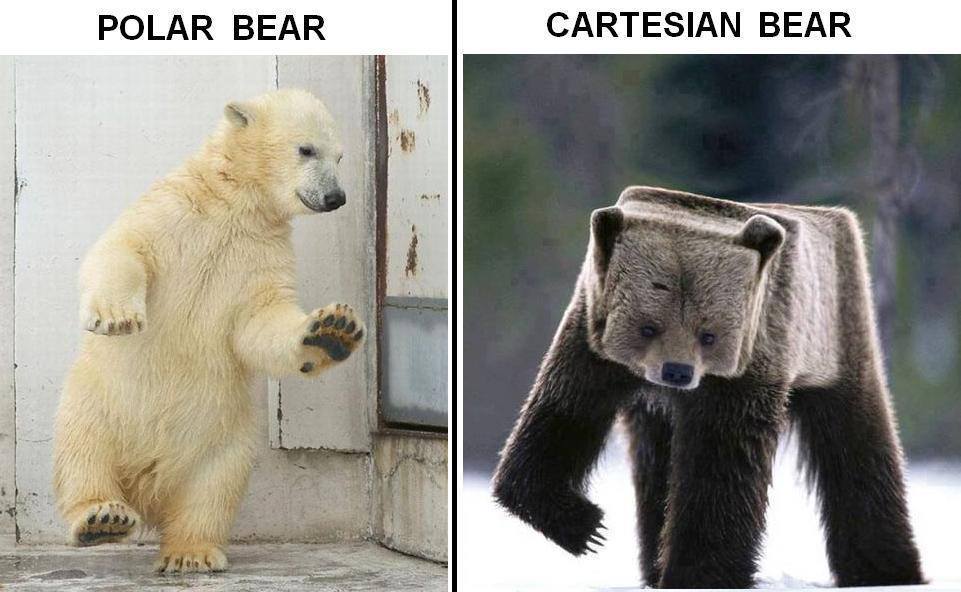
Draw a bear in polar coordinates, and then Cartesian coordinates.
- Draw a bear in polar coordinates, and then Cartesian coordinates.....
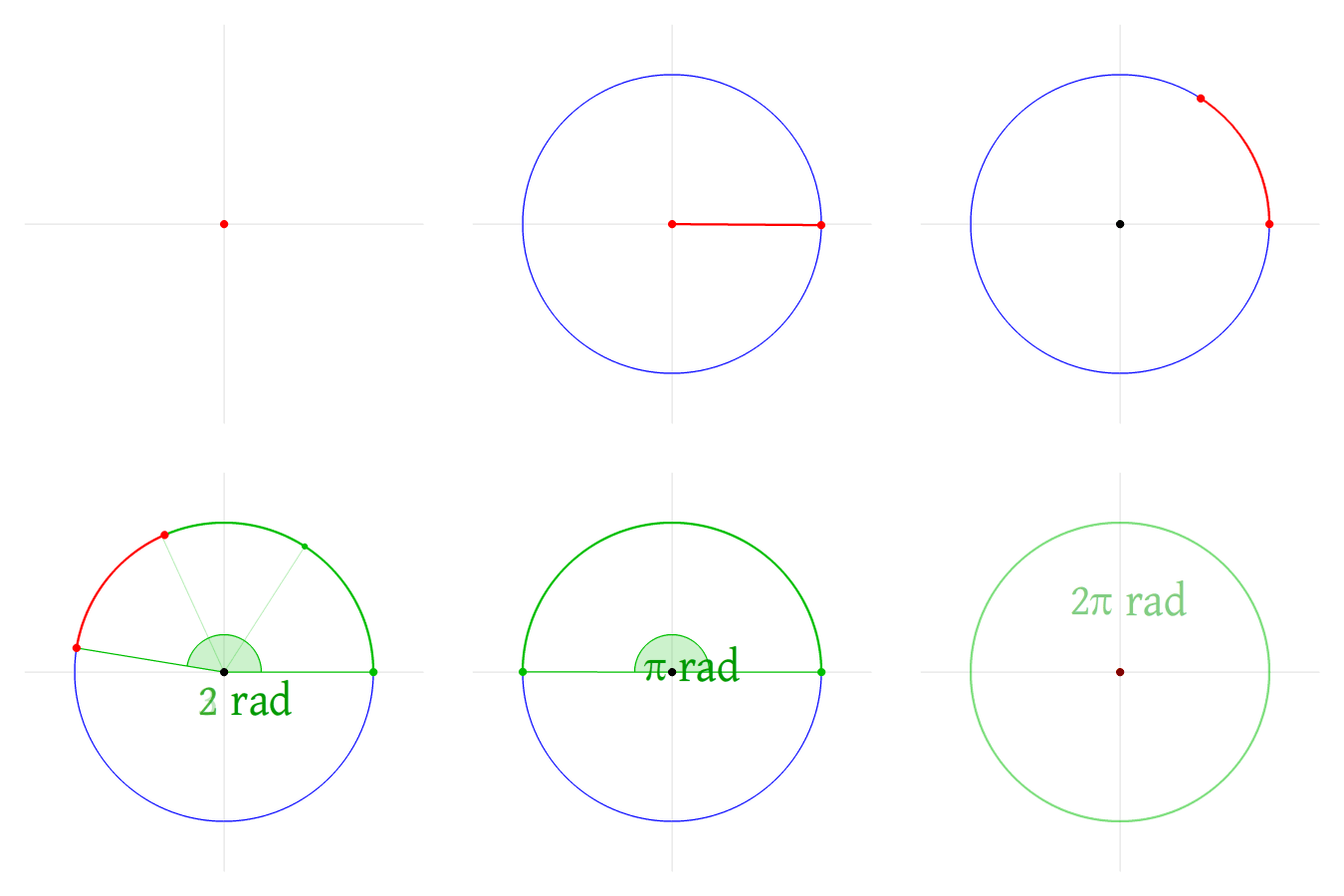
The image below, from Wikipedia, illustrates the definition of radians. Note that radian measure is defined as the ratio of the arc length traveled over the radius. Radian measure is unitless, because it involves a ratio of two lengths.
- If we travel $2\pi$ units along the outer edge of a disc of radius 6 units, then through what central angle, in radians, did we traverse?
Solution
The definition of radian measure is given by $$\text{radian measure} = \frac{\text{arc length}}{\text{radius of circle}}\quad \text{or}\quad \theta = \frac{s}{r}.$$ We've traveled (arc length) $s=2\pi$ units along a circle with radius $r=6$. The radian measure is $$\theta = \frac{s}{r} = \frac{2\pi}{6} = \frac{\pi}{3}.$$
Note that $s = r\theta$. In particular, note that if the angle we traverse is a little angle $d\theta$, then the little distance traveled is $$ds = rd\theta.$$
- Compute the polar double integral $\ds \int_0^{2\pi}\int_{0}^{7} r\, dr d\theta$.
Solution
With Mathematica, we can quickly get the answer using either of the following. Notice the order for bounds.
Integrate[Integrate[r, {r, 0, 7}], {theta, 0, 2 Pi}]
Integrate[r, {theta, 0, 2 Pi}, {r, 0, 7}]
By hand, we compute $$\ds \int_0^{2\pi}\int_{0}^{7} r\, dr d\theta = \int_0^{2\pi}\frac{r^2}{2}\bigg|_0^{7} d\theta = \int_0^{2\pi}\frac{7^2}{2} d\theta = \frac{7^2}{2}\theta\bigg|_0^{2\pi} = \pi7^2. $$ This shows that that area inside a circle of radius $7$ is $\pi 7^2$. Changing the 7 to an an arbitrary radius $a$, the above work shows that the area inside a circle of radius $a$ is $\pi a^2$.
- For the change-of-coordinates $u=x+y$ and $v=x-y$, compute the Jacobians $\ds \frac{\partial (u,v)}{\partial (x,y)}$ and $\ds \frac{\partial (x,y)}{\partial (u,v)}$.
Solution
Differentials give $du = 1dx+1dy$ and $dv = 1dx-1dy$, which we can write as the linear combination $$\begin{pmatrix}du\\dv\end{pmatrix} = \begin{pmatrix}1\\1\end{pmatrix}dx + \begin{pmatrix}1\\-1\end{pmatrix}dy.$$ We have $u$ and $v$ in terms of $x$ and $y$, which means the Jacobian of $u$ and $v$ with respect to $x$ and $y$ is $$\frac{\partial(u,v)}{\partial(x,y)} = |(1)(-1)-(1)(1)| = 2.$$
How do we find $\ds \frac{\partial (x,y)}{\partial (u,v)}$? This notation means we need $x$ and $y$ in terms of $u$ and $v$. We just have to solve $u=x+y$ and $v=x-y$ for $x$ and $y$. Summing the equations gives $u+v = 2x$. Subtraction yields $u-v = 2y$. This means $$x = \frac{u+v}{2}, y = \frac{u-v}{2}.$$ Differentials give $$\begin{pmatrix}dx\\dy\end{pmatrix} = \begin{pmatrix}1/2\\1/2\end{pmatrix}du + \begin{pmatrix}1/2\\-1/2\end{pmatrix}dv.$$ The area of the parallelogram formed by the partial derivatives gives $$\frac{\partial(x,y)}{\partial(u,v)} = |(1/2)(-1/2)-(1/2)(1/2)| = 1/2.$$
Note that $\frac{\partial(u,v)}{\partial(x,y)} = (\frac{\partial(x,y)}{\partial(u,v)})^{-1}$. This is not a coincidence.
- Set up an iterated integral, using polar coordinates, that would give the area in the second quadrant inside a circle or radius 5 that is centered at the origin.
Solution
The area is $\ds\iint_RdA =\iint_Rr drd\theta = \int_{\pi/2}^{\pi}\int_0^{5}rdrd\theta$.
Let's use Mathematica to compute the integral and plot the region.
outerB = {theta, Pi/2, Pi};
innerB = {r, 0, 5};

Integrate[r, outerB, innerB]

coordinates = {r Cos[theta], r Sin[theta]};
ParametricPlot[coordinates, outerB, innerB, Mesh -> {10, 0}]
- Set up iterated integral formulas, using polar coordinates, that would give the centroid (center of mass, assuming constant density) of the region above.
Solution
The centroid $(\bar x, \bar y)$ is the point that gives the average $(x,y)$ coordinates of the points in the region. It's the geometric center, and variable densities are ignored. These are just average $x$ and $y$ values, so we use the average value formula $\bar f = \frac{\iint_R f dA}{\iint_R dA}$, with $f$ equal to $x$ and $y$ respectively, to obtain
- $\ds\bar x = \frac{\iint_RxdA}{\iint_RdA} =\frac{\iint_R(r\cos\theta)rdrd\theta}{\iint_Rrdrd\theta} = \frac{\int_{\pi/2}^{\pi}\int_0^{5}(r\cos\theta)rdrd\theta}{\int_{\pi/2}^{\pi}\int_0^{5}rdrd\theta}$ and
- $\ds\bar y = \frac{\iint_RxdA}{\iint_RdA} =\frac{\iint_R(r\sin\theta)rdrd\theta}{\iint_Rrdrd\theta} = \frac{\int_{\pi/2}^{\pi}\int_0^{5}(r\sin\theta)rdrd\theta}{\int_{\pi/2}^{\pi}\int_0^{5}rdrd\theta}$.
With Mathematica, we can quickly compute these, with the last line below drawing the region to help us verify we've got the correct region.
outerB = {theta, Pi/2, Pi};
InnerBounds = {r, 0, 5};

Integrate[(r Cos[theta]) r, outerB, innerB]/
 Integrate[r, outerB, innerB]
Integrate[(r Sin[theta]) r, outerB, innerB]/
 Integrate[r, outerB, innerB]

coordinates = {r Cos[theta], r Sin[theta]};
ParametricPlot[coordinates, outerB, innerB, Mesh -> {10, 0}]
Group Problems
- Consider the change-of-coordinates $x=r\cos\theta$ and $y=r\sin\theta$.
- Compute the differential $(dx,dy)$ and write it as a linear combination.
- Compute the Jacobian of this change-of-coordinates, so compute the area of the parallelogram whose edges are given by the vectors $(\cos\theta, \sin\theta)$ and $(-r\sin\theta, r\cos\theta)$ (the partial derivatives of the change-of-coordinates). Simplify your answer as much as possible, as we'll use this result quite often.
- Consider the triangle in the first quadrant satisfying $0\leq y\leq 1$ and $0\leq x\leq y$. We'll assume constant density $\delta =1$.
- Draw the triangle, and make a guess where the center of mass is located.
- Compute the integral formula $\bar x = \ds\frac{\int_{0}^{1}\int_0^y x dxdy}{\int_{0}^{1}\int_0^y 1 dxdy}.$ [Check: (1/6)/(1/2)=1/3.]
- Compute the integral formula $\bar y = \ds\frac{\int_{0}^{1}\int_0^y y dxdy}{\int_{0}^{1}\int_0^y 1 dxdy}.$ [Check: (1/3)/(1/2)=2/3.]
- Consider the integral $\ds\int_{0}^{3}\int_{0}^{x}dydx$.
- Shade the region whose area is given by this integral. (You should obtain a triangle whose area is 9/2, the value of the integral above).
- Someone naively tries to swap the order of integration thinking it's as simple as $\ds\int_{0}^{x}\int_{0}^{3}dxdy$. Compute the integral and show that you do not get a number for the area. How can you recognize there will be a problem without even computing any integrals?
- Correctly adjust the bounds on the previous integral (using the order $dxdy$) so that the bounds describe the same region as original integral, making sure the bounds on $y$ are between two constants. In other words, fill in the question marks below so that the integral's bounds describe the same region as the first part of this problem. $$\ds\int_{?}^{?}\int_{?}^{?}dxdy.$$
- Set up an integral formula to compute each of the following:
- The mass of a disc that lies inside the circle $x^2+y^2=9$ and has density function given by $\delta = x+10$
- The $x$-coordinate of the center of mass (so $\bar x$) of the disc above.
|
Sun |
Mon |
Tue |
Wed |
Thu |
Fri |
Sat |