
- I-Learn, Class Pictures, Learning Targets, Text Book Practice
- Prep Tasks: Unit 1 - Motion, Unit 2 - Derivatives, Unit 3 - Integration, Unit 4 - Vector Calculus
We still have some tasks from Day 42 to finish discussing in class.
Day 42 - Prep
Task 42.1
Imagine that the vector field $\vec F(x,y,z)$ represents the velocity of some fluid at point $(x,y,z)$. Let $S$ be a surface (you could think of water flowing through a fish net) through which the fluid will flow. The flux of $\vec F$ across $S$ is the rate at which the fluid flows through the surface.


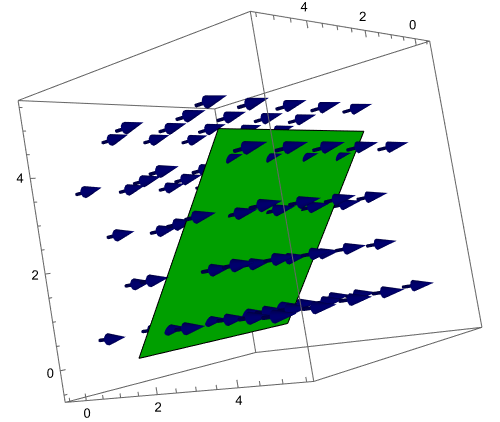
- In the pictures above, the velocity is given by $\vec F = (0,2,0)$ meters per second and the green surface $S$ is a square with surface area 25 square meters. For each picture above, let's determine the flux of $\vec F$ across $S$.
- Explain why the flow rate of $\vec F$ through $S$ for the first image above is 50 cubic meters per second.
- Explain why the flow rate of $\vec F$ through $S$ for the second image above is 0 cubic meters per second.
- In the third image, the edges of the parallelogram are given by $\vec u = (5,0,0)$ and $\vec v = (0,3,4)$. Compute the flow rate of $\vec F$ through $S$.
In our computations above, we were not concerned about which direction the fluid flowed through the surface. In general, we'll keep track of which direction a fluid flows through a surface, and count flux as negative when the fluid flows the opposite direction. To do this, we pick a unit vector $\hat n$ to the surface, called an orientation of $S$, and decide flux is positive precisely when the vector component of $\vec F$ that is parallel to $\hat n$ is in the same direction as $\hat n$.
- In the third image above, a normal vector to the surface is $\vec u\times \vec v = (5,0,0)\times (0,3,4) = (0,20,-15)$, which means we can use $\hat n = \frac{\vec u\times \vec v}{|\vec u\times \vec v|} = \frac{1}{5}(0,4,-3)$ as an orientation for $S$. Show that the flux of $\vec F$ across $S$ with the orientation $\hat n$ is $ ( \vec F\cdot \hat n)( \text{Surface Area of $S$ } )$.
The computations above generalize rapidly to provide a method for computing the flux of a vector field $\vec F$ across a surface $S$ in the direction of $\hat n$. For a vector field $\vec F$ and surface $S$ with orientation $\hat n$, we have used $dS$ to represent small bits of surface area. This means a small amount of flux across $S$ is given by $d\text{Flux} = \vec F\cdot \hat n dS$. Summing these, and computing a limit provides the flux as $$\text{Flux}=\Phi = \iint_S \vec F\cdot \hat n dS.$$ Note that because $\hat n$ is a unit normal vector to $S$, then given a parametrization $\vec r(u,v)$ of $S$ for $(u,v)$ in some region $R$, we know $\hat n = \pm \frac{\vec r_u\times \vec r_v}{|\vec r_u\times \vec r_v|} $ while $dS = |\vec r_u\times \vec r_v|dudv$. This means we can simplify the flux integral above to $$\text{Flux}=\Phi = \iint_R \vec F \cdot (\pm\vec r_u\times \vec r_v)dudv,$$ where the $\pm$ sign must be determined based on the orientation of the surface.
- Let $\vec F = (x^2 + y, y - z, 3 x + 2 z)$ and $S$ be the surface parametrized by $\vec r(u,v) = (3 \cos v,u,3\sin v)$ for $1\leq u\leq 5$ and $0\leq v\leq 2\pi$. Let $\hat n$ be the unit normal to $S$ which points outwards, away from the $y$-axis. Compute the outward flux $\Phi$ of $\vec F$ across $S$. The steps below can serve as a guide.
- Compute $\vec r_u$ and $\vec r_v$.
- Compute a normal vector $\vec N = \vec r_u \times \vec r_v$, and decide if $\vec N$ points in the same, or opposite direction, as the orientation $\hat n$. This may require you to draw the surface to visually make that determination.
- Insert all the known values into $\iint_R \vec F\cdot (\pm\vec r_u\times \vec r_v)dudv$, making sure all variables have been written in terms of $u$ and $v$. Then use software to compute the integral. (I got $72\pi$.)
- Let $\vec F = (2 y z, x + 3 y, -z^2)$ and $S$ be the surface parametrized by $\vec r(u,v) = (u \cos v, u \sin v, 9 - u^2)$ for $0\leq u\leq 3$ and $0\leq v\leq 2\pi$. Compute the upward ($\hat n$ has positive $z$-component) flux $\Phi$ of $\vec F$ across $S$ in the direction of $\hat n$. The steps above are still the same guide. (I got $-243\pi/2$.)
Task 42.2
For a surface $S$ with parametrization $\vec r(u,v) = (x(u,v),y(u,v),z(u,v))$ for $(u,v)$ in some region $R$, we have shown that surface area is $$S = \iint_S dS = \iint_R |\vec r_u\times\vec r_v|dudv.$$ This means we can compute mass, average values, centroids, centers-of-mass, etc, in a manner similar to what we have already done.
- For a function $f$ defined at points on the surface, the average value is $$\bar f = \frac{\iint_S f dS}{\iint_S dS} = \frac{\iint_R f(u,v) |\vec r_u\times\vec r_v| dudv}{\iint_R |\vec r_u\times\vec r_v| dudv}.$$ Replacing $f$ with $x$, $y$, or $z$ obtains the corresponding coordinate of the centroid of the surface.
- Given a density $\delta$ at points on the surface, the mass of the surface is $$ m = \iint_S dm = \iint_S \delta dS = \iint_R \delta(u,v) |\vec r_u\times\vec r_v| dudv.$$ The center-of-mass is given by $(\bar x, \bar y, \bar z) = \frac{\iint_S (x,y,z) \delta dS}{\iint_S \delta dS}$ which we can write as $$\begin{align*} \bar x &= \frac{\iint_R x(u,v) \delta(u,v) |\vec r_u\times\vec r_v| dudv}{\iint_R \delta(u,v) |\vec r_u\times\vec r_v| dudv},\\ \bar y &= \frac{\iint_R y(u,v) \delta(u,v) |\vec r_u\times\vec r_v| dudv}{\iint_R \delta(u,v) |\vec r_u\times\vec r_v| dudv},\\ \bar z &= \frac{\iint_R z(u,v) \delta(u,v) |\vec r_u\times\vec r_v| dudv}{\iint_R \delta(u,v) |\vec r_u\times\vec r_v| dudv}. \end{align*}$$
Note that there are lots of things going on with each integral. Software will greatly reduce the amount of time needed to set up and compute these integrals. The commands that will be most useful are ParametricPlot3D[], D[], Cross[], Norm[], and Integrate[].
- Consider the surface $\vec r(u,v) = (3\cos v,3\sin v, u)$ for $1\leq u\leq 5$ and $0\leq v\leq \pi$. Start by drawing the surface. From your picture, state $\bar x$ and $\bar z$. Then set up and compute an integral formula that gives the $y$-coordinate of the centroid.
- A satellite dish lies along the parametric surface $\vec r(u,v) = (u^2, u\cos v, u\sin v)$ for $0\leq u\leq 2$ and $0\leq v\leq 2\pi$. Start by drawing the surface. The temperature at points on and near the dish is given by $T(x,y,z) = x+z$. Set up and compute an integral formula that gives the average temperature of the satellite dish.
- The top half of the surface $S$ of a donut (a torus) can be parametrized by $\vec r(u,v) = ((5 - 3 \cos u) \cos v, (5 - 3 \cos u) \sin v, 3 \sin u)$ for $0\leq u\leq \pi$ and $0\leq v\leq 2\pi$. Imagine that someone puts icing on the top of this donut (so creates a surface), but the thickness of the icing is more on the top of the donut than on the sides. While not a perfect way to model this situation, we could use $\delta = kz$ for some constant $k$ as a way to model the surface with varying density. Show that the center-of-mass of the surface $S$ with density function $\delta = kz$ is $(\bar x, \bar y, \bar z) = (0,0,\frac{3\pi}{4})$.
Task 42.3
We've seen all the new notation that we'll encounter for the rest of the semester. This task has us practice using the notation we've learned.
- Consider the vector field $\vec F = (x,x-z,y+z)$, the surface $S$ parametrized by $\vec r(u,v)=(u^2, u\cos v, u\sin v)$ for $0\leq u\leq 2$ and $0\leq v\leq 2\pi$, and the curve $C$ parametrized by $\vec r(t) = (4,2\cos t, 2\sin t)$ for $0\leq t\leq 2\pi$.
- Draw the surface $S$ and curve $C$. How are these two objects related?
- Compute $\vec N = \vec r_u\times \vec r_v$ and determine if $\vec N$ points inward toward the $x$-axis, or outwards away from the $x$-axis.
- Set up and compute the integral $\ds \int_C Mdx+Ndy+Pdz$, computing the work done by $\vec F$ along $C$.
- Set up and compute $\ds \iint_S \vec \nabla \times \vec F\cdot \hat n dS$, computing the flux of the curl of $\vec F$ across $S$ in the direction $\hat n$ outwards away from the $y$-axis.
- Consider the vector field $\vec F = (x,x-z,y+z)$, the solid domain $D$ that lies inside the sphere $x^2+y^2+z^2=25$, and the surface $S$ parametrized by $\vec r(u,v)=(5\sin v\cos u, 5 \sin v \sin u, 5 \cos v)$ for $0\leq u\leq 2\pi$ and $0\leq v\leq \pi$.
- Draw the surface $S$ and domain $D$. How are these two objects related?
- Compute $\vec N = \vec r_u\times \vec r_v$ and determine if $\vec N$ points inward toward the domain $D$ or outwards away from the domain $D$.
- Set up and compute $\ds \iint_S \vec F\cdot \hat n dS$ for $\hat n$ pointing outwards, away from the solid inside $S$. This computes the outward flux of $\vec F$ across $S$.
- Set up and compute $\ds \iiint_D \vec \nabla \cdot \vec F dV$, the triple integral of the divergence of $\vec F$ over the domain $D$.
Task 42.4
Pick some problems related to the topics we are discussing from the Text Book Practice page.
We still have some tasks from Day 44 to finish discussing in class.
Day 44 - Prep
Task 44.1
What do the curl and divergence of a vector field compute? How do we physically interpret them?
- Head to the following webpages and read their descriptions.
- After reading the 4 pages above, head to Wikipedia's article on magnetic fields, see https://en.wikipedia.org/wiki/Magnetic_field. Skim through the article (you do not need to read and comprehend all of it).
- Are there any new symbols you don't recognize? What are they?
- Search for the word "divergence" in the text, and read the paragraph(s) where you find it.
- Search for the word "curl" in the text, and read the paragraph(s) where you find it.
- Come with questions about anything you would like to discuss.
Task 44.2
As we proceed through the remainder of this unit, we'll find that three types of integrals appear quite often.
- Work integrals: $\ds\int_{C} Mdx+Ndy+Pdz$
- Surface integrals: $\ds \iint_S f(x,y,z) dS$
- Flux integrals: $\ds \iint_S \vec F \cdot \hat n dS$
For each type of integral above, use Mathematica to create a code chunk that you can use to compute each type of integral. This will allow you free yourself from performing tedious computations, letting you focus on bigger picture ideas.
- For the work integral, you can pick the vector field $\vec F(x,y,z)$, parametrization $\vec r(t)$, and bounds for $t$. Feel free to use an example from 42.3.
- For the surface integral, you can pick the surface $S$, function $f(x,y,z)$, parametriztion $\vec r(u,v)$, and bounds for $u$ and $v$. Feel free to use an example from 42.2.
- For the flux integral, you can pick the surface $S$, orientation $\hat n$, parametriztion $\vec r(u,v)$, and bounds for $u$ and $v$. Feel free to use an example from 42.1 or 42.3.
The ReplaceAll[] command in Mathematica will allow you to replace any instance of $x$, $y$, or $z$ with the corresponding value from your parametrization. This allows you to enter the vector field using Cartesian coordinates. Other commands you'll find useful are D[], Cross[], Norm[], Dot[], and Integrate[].
As an example, to dot the vector field $\vec F = (3x+4yz, 2y^2, x-4z)$ with the derivative of the parametrization $\vec r(t) = (3\cos t, 3\sin t, 4 t)$, and then make sure everything is in terms of $t$, we can use the following code.
F = {3 x + 4 y z, 2 y^2, x - 4 z}
r = {3 Cos[t], 3 Sin[t], 4 t}
ReplaceAll[Dot[F, D[r, t]], {x -> r[[1]], y -> r[[2]], z -> r[[3]]}]

(*Or using short cut notation (. for Dot and /. for ReplaceAll)*)
F . D[r, t] /. {x -> r[[1]], y -> r[[2]], z -> r[[3]]}
The notation r[[1]] accesses the first element from r, which is 3 Cos[t].
Task 44.3
Green's theorem connects circulation along a simple closed curve in 2D to an integral along the region inside the curve. The circulation per area (circulation density) is given by $N_x-M_y$ for a 2D vector field. A similar fact is true in 3D, namely if $S$ is a surface with a simple closed curve $C$ that forms the boundary of $S$, then the circulation along $C$ can be computed instead by summing circulation densities (circulation per surface area) along the surface. Given a point $(x,y,z)$ and a unit vector $\hat n$, we calculate the circulation density of $\vec F$ about $\hat n$ at $(x,y,z)$ in a similar manner, as follows.
- We construct a circle $C_a$ of radius $a$ in the plane through $(x,y,z)$ with normal vector $\hat n$.
- We compute the counter-clockwise circulation about $\hat n$, obtaining $\oint_{C_a} Mdx+Ndy+Pdz$.
- We divide by the area $A_a$ inside $C_a$, to obtain a circulation per area.
- The circulation density of $\vec F$ about $\hat n$ at $(x,y,z)$ is the limit $$\lim_{a\to 0}\frac{1}{A_a}\oint_{C_a} Mdx+Ndy+Pdz = \vec \nabla \times \vec F \cdot \hat n.$$
The curl of a vector field provides information about circulation density in every direction (just dot by the direction about which you want to know how things are rotating). Note that for a 2D vector field, we can use the normal vector $\hat n = (0,0,1)$, and then we see that the circulation density for a vector field in 2D is $$(N_z-P_y, P_x-M_z, N_x-M_y) \cdot (0,0,1) = N_x-M_y.$$
We're now ready to state Stokes's theorem.
Given an orientable differentiable parametric surface with unit normal vector (orientation) $\hat n$ and piecewise smooth boundary $\partial S$, where each portion of the boundary is oriented compatibly with $\hat n$ (see below for meaning), then the flux of the curl of $\vec F=(M,N,P)$ is equal to the circulation of $\vec F$ along $\partial S$, which we can write as $$\iint_S \vec \nabla \times \vec F \cdot \hat n dS = \int_{\partial S} Mdx+Ndy+Pdz.$$
- We use $\partial S$ to stand for the boundary of $S$. We are not taking partial derivatives of the surface, rather it's a notation convention.
- Note that $\partial S$ might consist of multiple curves, which may or may not be connected to each other. Sum $\int_{C} Mdx+Ndy+Pdz$ for each curve $C$ that is part of the boundary to compute $\int_{\partial S} Mdx+Ndy+Pdz$.
- We say that a curve $C$ is oriented compatibly with $\hat n$ provided that the surface is on the left side of $C$ when viewing the surface from the side designated by $\hat n$. As you wrap your right hand about the vector $\hat n$, your hand should be moving in the same direction as the orientation on $C$.
Let's verify this theorem in some examples.
- Let $\vec F(x,y,z) = (x+2y, 3x-4z, 2z)$. Consider the surface $S$ parametrized by $\vec r(u,v) = (u\cos v, u\sin v, u^2)$ for $0\leq u\leq 3$ and $0\leq v\leq 2\pi$ with orientation $\hat n$ pointing away from the $z$-axis. The boundary $\partial S$ consists of a single curve $C_1$ parametrized by $\vec r_1(t) = (3\cos t, 3\sin t, 9)$ for $0\leq t\leq 2\pi$.
- Draw the surface and curve. Do your best to explain what it means for $\hat n$ and the curve to be oriented compatibly.
- Set up and compute the surface integral $\ds \iint_S \vec \nabla \times \vec F \cdot \hat n dS$.
- Set up and compute the line integral $\ds \int_{\partial S} Mdx+Ndy+Pdz$. Do you get the same result as the surface integral?
- Let $\vec F(x,y,z) = (x+2y, 2x+4z, 4y)$. Consider the plane in the first octant with the three vertices $(3,0,0)$, $(0,3,0)$ and $(0,0,3)$. An equation of the plane is $x+y+z=3$, which we can parameterize using $\vec r(u,v) = (u,v,3-u-v)$ for $0\leq u\leq 3$ and $0\leq v\leq 3-u$. The boundary $\partial S$ consists of 3 curves, which we can parameterize using $$\begin{align*}
\vec r_1(t) &= (3-3t,3t,0) \quad \text{for} 0\leq t\leq 1,\\
\vec r_2(t) &= (0,3-3t,3t) \quad \text{for} 0\leq t\leq 1,\\
\vec r_3(t) &= (3t,0,3-3t) \quad \text{for} 0\leq t\leq 1.
\end{align*}$$
- Draw the surface and 3 curves, placing an arrow on the curves to demonstrate the direction of motion.
- Compute $\ds \int_{\partial S} Mdx+Ndy+Pdz$ by computing the three line integrals and summing the result.
- Compute $\ds \iint_S \vec \nabla \times \vec F \cdot \hat n dS$, using an orientation $\hat n$ that is compatible with the orientation of the curves.
Task 44.4
Pick some problems related to the topics we are discussing from the Text Book Practice page.
Day 45 - Prep
Task 45.1
We've discussed circulation density and connected it to the curl of a vector field. Let's construct a corresponding analog for flux.
Given a point $(x,y,z)$, we calculate the flux density of $\vec F$ at $(x,y,z)$ as follows.
- We construct a sphere $S_a$ of radius $a$ centered at $(x,y,z)$.
- We compute the outward flux of $\vec F$ across the surface of the sphere, so $\iint_{S_a} \vec F\cdot\hat n dS$.
- We divide by the volume $V_a$ inside $S_a$, to obtain a flux per volume.
- The flux density of $\vec F$ at $(x,y,z)$ is the limit $$\lim_{a\to 0}\frac{1}{V_a}\iint_{S_a}\vec F\cdot\hat n dS = \vec \nabla \cdot \vec F.$$
The divergence of a vector field provides the flux density.
We are now ready to state the divergence theorem.
Given a solid domain $D$ with piecewise smooth boundary $\partial D$, where each portion of the boundary is a surface oriented pointing outwards away from $D$, then the integral of the divergence of $\vec F=(M,N,P)$ along $D$ is equal to the outward flux of $\vec F$ across the boundary $\partial D$, which we can write as $$\iiint_D \vec \nabla \cdot \vec F dV = \iint_{\partial D}\vec F\cdot\hat n dS.$$
- Note that $\partial D$ might consist of multiple surfaces. Sum $\iint_{S}\vec F\cdot\hat n dS$ for each surface $S$ that is part of the boundary to compute $\iint_{\partial D}\vec F\cdot\hat n dS$.
- For every surface $S$ that is part of the boundary, remember to make sure $\hat n$ is the outward pointing unit vector, pointing away from the solid domain $D$.
Let's verify this theorem in some examples.
- Consider the vector field $\vec F = (x^2, 2 y, x + y + z)$ and sphere of radius 5. We can parameterize the surface $S$ using $\vec r(u,v) = (5 \cos(u)\sin(v),5\sin(u)\sin(v),5\cos(v))$ for $0\leq u\leq 2\pi$ and $0\leq v\leq \pi$. The solid domain $D$ satisfies $\rho\leq 5$ (using spherical coordinates - you'll need appropriate bounds for $\theta$ and $\phi$). Set up and compute both $\iiint_D \vec \nabla \cdot \vec F dV$ and $\iint_{\partial D}\vec F\cdot\hat n dS$, using the outward pointing normal vector $\hat n$. (I got $500\pi$ for both. Pay attention to the direction in which $\vec r_u\times \vec r_v$ points.)
- Consider the vector field $\vec F = (5x,x-z,y+z+1)$ and solid domain $D$ in space that lies below the paraboloid $z=1-r^2$ (using cylindrical coordinates) and above the $xy$-plane. The boundary of $D$ consists of two surfaces. The top surface is parametrized by $\vec r(u,v) = (u \cos v,u \sin v,1-u^2)$ for $0\leq u\leq 1$ and $0\leq v\leq 2\pi$. The bottom surface is the plane $z=0$, and for this particular problem we can parameterize it using $\vec r(u,v) = (u\cos v,u\sin v,0)$ for $0\leq u\leq 1$ and $0\leq v\leq 2\pi$. Set up and compute both $\iiint_D \vec \nabla \cdot \vec F dV$ and $\iint_{\partial D}\vec F\cdot\hat n dS$, using the outward pointing normal vector $\hat n$. (I got $3\pi$ for both. The flux integral across the top surface is $4\pi$, and across the bottom surface is $-\pi$.)
Task 45.2
Stokes's theorem can be applied when the boundary of a surface consists of disjoint curves. Remember to check if the parametrization associated with each curve is compatible with the orientation on the surface. When not compatible, a simple negative sign can quickly fix any issues.
Let $\vec F = (2x-3y,x^2+2z,4xy)$.
- Consider the surface $S$ parametrized by $\vec r(u,v) = (u\cos v, u, u \sin v)$ for $1\leq u\leq 3$ and $0\leq v\leq 2\pi$, oriented by $\hat n$ pointing away from the $y$-axis. The boundary $\partial S$ of $S$ is the union of the two disconnected curves $C_1$ with parametrization $\vec r_1(t) = (\cos t, 1, \sin t)$ for $0\leq t\leq 2\pi$ and $C_2$ with parametrization $\vec r_2(t) = (3\cos t, 3, 3\sin t)$ for $0\leq t\leq 2\pi$. Provided the curves are oriented compatibly with $\hat n$, Stokes's theorem states that $$\ds \int_{\partial S} Mdx+Ndy+Pdz = \iint_S \vec \nabla \times \vec F \cdot \hat n dS.$$
- Draw the surface and curves.
- Compute $\ds \iint_S \vec \nabla \times \vec F \cdot \hat n dS$. (I got $104\pi$.)
- Compute $\ds \int_{C_1} Mdx+Ndy+Pdz$ and $\ds \int_{C_2} Mdx+Ndy+Pdz$, using the parametrizations provided.
- Explain how to combine the results of the previous computations to obtain $\ds \int_{\partial S} Mdx+Ndy+Pdz$.
- Now instead let $S$ be half of the surface above, parametrized by $\vec r(u,v) = (u\cos v, u, u \sin v)$ for $1\leq u\leq 3$ and $0\leq v\leq \pi$. The boundary of $S$ now consists of 4 connected curves, two arcs and two straight lines. One arc has parametrization $\vec r_1(t) = (\cos t, 1, \sin t)$ for $0\leq t\leq \pi$. One of the straight lines has parametrization $\vec r_2(t) = (t, t, 0)$ for $1\leq t\leq 3$.
- Compute $\ds \iint_S \vec \nabla \times \vec F \cdot \hat n dS$ (change the bounds of what you did in the previous part).
- Give parametrizations for the other two curves that make up $\partial S$.
- Compute $\ds \int_{C} Mdx+Ndy+Pdz$ for each of the 4 curves in $\partial S$. (You'll end up with $6+2\pi$, $54+54\pi$, $14/3$, and $86/3$, all of which could be negative instead of positive, based on your parametrization.)
- Explain how to combine the results of the previous computations to obtain $\ds \int_{\partial S} Mdx+Ndy+Pdz$.
Task 45.3
At this point, we've seen all the topics for the semester, and just need to make sure we practice them all. If you haven't yet, please create blocks of Mathematica code that will help you quickly compute work, surface integrals, and flux integrals, as well as quickly see $\vec r_u\times \vec r_v$ so you can make decisions about in which direction this normal vector points. I'll add more problems for later days. If you want more to work on before then, head to OpenStax and tackle any of the problems in 6.6, 6.7, or 6.8.
Task 45.4
Pick some problems related to the topics we are discussing from the Text Book Practice page.
Day 45 - In class
Brain Gains (Rapid Recall, Jivin' Generation)

- The top half of the surface $S$ of a donut (a torus) can be parametrized by $\vec r(u,v) = ((5 - 3 \cos u) \cos v, (5 - 3 \cos u) \sin v, 3 \sin u)$ for $0\leq u\leq \pi$ and $0\leq v\leq 2\pi$. Imagine that someone puts icing on the top of this donut (so creates a surface), but the thickness of the icing is more on the top of the donut than on the sides. While not a perfect way to model this situation, we could use $\delta = kz$ for some constant $k$ as a way to model the surface with varying density. Set up an integral to compute the $z$-coordinate of the center-of-mass of the surface $S$ with density function $\delta = kz$. Note that after quite a bit of computation, we can obtain $|\vec r_u\times \vec r_v| = 3 \sqrt{(5-3 \cos u)^2}$.
Solution
We compute $$\bar z = \frac{\iint_S z \delta dS}{\iint_S \delta dS} = \frac{\int_{0}^{\pi}\int_{0}^{2\pi} (3 \sin u) (k 3 \sin u)3 \sqrt{(5-3 \cos u)^2}dvdu}{\int_{0}^{\pi}\int_{0}^{2\pi} (k 3 \sin u) 3 \sqrt{(5-3 \cos u)^2}dvdu} .$$ The following Mathematica code will compute all related quantities.
ClearAll[r, u, v, uB, vB, n]
r = {(5 - 3 Cos[u]) Cos[v], (5 - 3 Cos[u]) Sin[v], 3 Sin[u]};
uB = {u, 0, Pi};
vB = {v, 0, 2 Pi};
n = Cross[D[r, u], D[r, v]];
Norm[n] // ComplexExpand // TrigReduce // FullSimplify
ParametricPlot3D[r, uB, vB]
Integrate[(z k z Norm[n]) /. z -> (3 Sin[u]), uB, vB]/
 Integrate[(k z Norm[n]) /. z -> (3 Sin[u]), uB, vB]
Given a solid domain $D$ with piecewise smooth boundary $\partial D$, where each portion of the boundary is a surface oriented pointing outwards away from $D$, then the integral of the divergence of $\vec F=(M,N,P)$ along $D$ is equal to the outward flux of $\vec F$ across the boundary $\partial D$, which we can write as $$\iiint_D \vec \nabla \cdot \vec F dV = \iint_{\partial D}\vec F\cdot\hat n dS.$$
- Note that $\partial D$ might consist of multiple surfaces. Sum $\iint_{S}\vec F\cdot\hat n dS$ for each surface $S$ that is part of the boundary to compute $\iint_{\partial D}\vec F\cdot\hat n dS$.
- For every surface $S$ that is part of the boundary, remember to make sure $\hat n$ is the outward pointing unit vector, pointing away from the solid domain $D$.
- Consider the vector field $\vec F = (x,x-z,y+z)$, the solid domain $D$ that lies inside the sphere $x^2+y^2+z^2=25$, and the surface $S$ parametrized by $\vec r(u,v)=(5\sin v\cos u, 5 \sin v \sin u, 5 \cos v)$ for $0\leq u\leq 2\pi$ and $0\leq v\leq \pi$.
- Draw the surface $S$ and domain $D$. How are these two objects related?
- We can compute $\vec N = \vec r_u\times \vec r_v = (-25 \cos u \sin ^2 v,-25 \sin u \sin ^2 v,-25 \sin v \cos v)$. Determine if $\vec N$ points inward toward the domain $D$ or outwards away from the domain $D$.
- Set up $\ds \iint_S \vec F\cdot \hat n dS$ for $\hat n$ pointing outwards, away from the solid inside $S$. This computes the outward flux of $\vec F$ across $S$.
- Set up and compute $\ds \iiint_D \vec \nabla \cdot \vec F dV$, the triple integral of the divergence of $\vec F$ over the domain $D$.
Solution
We are on a sphere. As such, at the point $(x,y,z)$ one option for a normal vector is $(x,y,z)$ (point straight out from where you are at), while another is $(-x,-y,-z)$ (point straight back towards the origin). Note that on the surface, we have $x = 5\sin v\cos u$ while the $x$-component of $\vec N$ is $-25 \cos u \sin ^2 v =-5x\sin v$. Because $x$ and $-5x\sin v$ will always have opposite sign, this means that $\vec N$ points inwards. To compute outwards flux, we must multiply $\vec N$ by a negative.
The code below computes the normal vector n, and computes both the flux and triple integral of the divergence.
F = {x^2, 2 y, x + y + z};
r = {5 Cos [u] Sin[v], 5 Sin[u] Sin[v], 5 Cos[v]};
uB = {u, 0, 2 Pi};
vB = {v, 0, Pi};
ParametricPlot3D[r, uB, vB]

n = Cross[D[r, u], D[r, v]] // Simplify

Integrate[F . (-n) /. {x -> r[[1]], y -> r[[2]], z -> r[[3]]}, uB, vB]

Div[F, {x, y, z}]

(*For spherical coordinates, remember we need the Jacobian.*)
Integrate[(3 + 2 rho Cos[theta] Sin[phi]) rho^2 Sin[phi], {rho, 0, 5}, {theta, 0, 2 Pi}, {phi, 0, Pi}]
This chunk of code shows the vector field at points along the surface, so we can visually see that the outward flux is positive.
surface = ParametricRegion[r, Evaluate[{uB, vB}]];
SliceVectorPlot3D[F, surface, {x, -5, 5}, {y, -5, 5}, {z, -5, 5}]
SliceVectorPlot3D[F, surface, {x, -5, 5}, {y, -5, 5}, {z, -5, 5}, VectorScaling -> Automatic, VectorSizes -> Automatic]
Group Problems
- For the cone $\vec r(u,v) = (u, u\cos v, u\sin v)$ for $0\leq u\leq 5$ and $0\leq v\leq 2\pi$, set up the integrals needed to compute the center-of-mass of the cone if density at points in the cone is given by $\delta = (x+z+10)$.
- Set up an integral to compute the flux of $\vec F = (2x+3y, -3x+4z, 4y+z^2)$ across the surface of the cone from above, using the outward (away from $x$-axis) orientation.
Day 46 - Prep
Continue working on the tasks from Day 45 and Day 44.
|
Sun |
Mon |
Tue |
Wed |
Thu |
Fri |
Sat |