
- I-Learn, Class Pictures, Learning Targets, Text Book Practice
- Prep Tasks: Unit 1 - Motion, Unit 2 - Derivatives, Unit 3 - Integration, Unit 4 - Vector Calculus
Day 25 - Prep
We are beginning a new unit on integration.
Task 25.1
We need to become adept at describing regions in the plane, using inequalities. For this first task, we'll start with inequalities and from them shade a region in the plane.
- Shade the region in the $xy$-plane that satisfies the inequalities $-1\leq x\leq 1$ and $1-x\leq y\leq 4-x^2$.
- Shade the region in the $xy$-plane that satisfies the inequalities $-3\leq y\leq 0$ and $0\leq x\leq \sqrt{9-y^2}$.
- Shade the region in the $xy$-plane that satisfies the polar coordinate inequalities $0\leq \theta\leq \pi$ and $1\leq r\leq 3$.
- Shade the region in the $xy$-plane that satisfies the polar coordinate inequalities $-\frac{\pi}{6}\leq \theta \leq \frac{\pi}{6}$ and $0\leq r\leq 4\cos 3\theta$.
- Shade the region in the $xy$-plane that satisfies the polar coordinate inequalities $0\leq \theta\leq \frac{3\pi}{2}$ and $1\leq r\leq 3+2\cos\theta$.
We can also describe solid regions in space, using 3 sets of inequalities.
- Draw the region in space that satisfies the inequalities $0\leq x\leq 3$, $-1\leq y\leq 1$, and $0\leq z\leq 1-y^2$.
- Draw the region in space that satisfies the inequalities $-1\leq x\leq 1$, $0\leq y\leq 1-x^2$, and $0\leq z\leq 1-y$.
We will soon see that the area of the first region is given by the iterated double integral $\ds\int_{x=-1}^{x=1}\left(\int_{y=1-x}^{y=4-x^2}dy\right) dx$, written more compactly as $\ds\int_{-1}^{1}\int_{1-x}^{4-x^2}dy dx.$ The area of the second region is given by $\ds\int_{-3}^{0}\int_{0}^{\sqrt{9-y^2}}dx dy.$
The polar regions have areas given by the iterated double integrals $\ds\int_{0}^{\pi}\int_{1}^{3}rdr d\theta$, $\ds\int_{-\frac{\pi}{6}}^{\frac{\pi}{6}}\int_{0}^{4\cos 3\theta}rdr d\theta$, and $\ds\int_{0}^{\frac{3\pi}{2}}\int_{1}^{3+2\cos\theta}rdr d\theta$.
The regions in space have a volume given by the iterated triple integrals $\ds\int_{0}^{3}\int_{-1}^{1}\int_{0}^{1-y^2}dz dy dx$ and $\ds\int_{-1}^{1}\int_{0}^{1-x^2}\int_{0}^{1-y}dz dy dx$.
Task 25.2
One way to compute the area of a region $R$ is overlay the region with a rectangular grid, where $dx$ and $dy$ are the distances between the vertical and horizontal lines of the grid. To find the area of the region, we first determine which of the rectangles contains a portion of the region $R$, and then add up the areas of of all such rectangles. This will overestimate the area, but we can then use limits to shrink both $dx$ and $dy$ to zero to obtain the area.
Consider the polar curve $r=1+\cos\theta$. We will use the approach described above to estimate the area of region $R$ that is inside this polar curve. We'll assume that all distances are given in meters. The bounds for each graph below are $-1\leq x\leq 2$ and $-2\leq y\leq 2$.
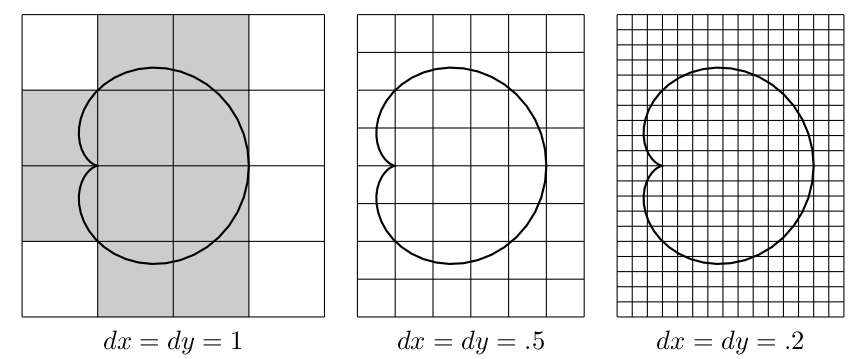
- For the first picture above, there are 10 rectangles (shaded) that contain a portion of the region $R$. Each of these rectangles has area $dA=dxdy=(1)(1) = 1 $, which means an overestimate for the area of $R$ is $A\approx 10 \, dA = 10(1)=10$. Describe a way to use these same rectangles to get an underestimate for the area of $R$.
- Now use the middle picture above (where $dx=dy=.5$) to shade and then count the number of rectangles that contain a portion of $R$. What is the area $dA$ of each little rectangle. Finish by giving an estimate for $A$.
- Now use the last picture with $dx=dy=.2$ to estimate the area of $R$.
- How can we obtain the exact value for the area of $R$?
- The questions above help focus on finding area, because each rectangle was given the same importance in the overall sum. Suppose instead that an object is made in the shape of the cardioid, but the portion that lies above the $x$-axis has a density of 2 kg/m^2, while the portion below has a density of 3 kg/m^2. How would you modify your work above to give an estimate for the mass (in kg)?
Task 25.3
In this task, we'll focus on the integrals $\int_C dx$ and $\int_C dy$, and from them develop a way to compute area using iterated (repeated) integrals.
- Consider the portion of the ellipse parametrized by $\vec r(t) = (3\cos t, 4\sin t)$ for $0\leq t\leq \pi/2$. Notice that parametrization starts at $(3,0)$ and ends at $(0,4)$. The integral $\int_C dx$ literally says ``Sum up little changes in $x$.'' Adding up little changes in $x$ gives the total change in $x$.
- Differentials gives us $dx = -3\sin t dt$. Compute $\ds\int_C dx=\int_{t=0}^{t=\pi/2}dx = \ds\int_{t=0}^{t=\pi/2}-3\sin t dt$ and verify that it gives the total change in $x$ from $t=0$ to $t=\pi/2$.
- Guess the value of $\ds\int_{t=0}^{t=\pi/2}dy$ (the integral adds up what?), and then check your solution.
- Consider the region $R$ between the functions $y=x^2$ and $y=-x$ for $0\leq x\leq 3$. Our goal is to explain why the iterated integral $\ds\int_{x=0}^{x=3}\left(\int_{y=-x}^{y=x^2} dy \right)dx$ gives the area of the region $R$.
- Draw both functions and shade the region $R$.
- Compute the integral $\ds\int_{y=-x}^{y=x^2}dy$ for arbitrary $x$. This integral comutes, for a given value of $x$, the total change in $y$ (so a height).
- Recall that $dx$ is a small width. When we multiply the previous integral by this width $dx$, we will obtain the area of a small rectangular region whose height is given by $\ds\int_{y=-x}^{y=x^2}dy$ and width is given by $dx$. Pick a value $x$ between 0 and 3, and then construct a picture that illustrates this rectangular region whose area is given by $dA=\ds\left(\int_{y=-x}^{y=x^2} dy \right)dx$.
- Explain why $\ds\int_{x=0}^{x=3}\left(\int_{y=-x}^{y=x^2} dy \right)dx$ gives the area of the region $R$.
- Consider the double integral $$\int_{y=-1}^{y=2}\left(\int_{x=y^2}^{x=y+2}dx\right)dy.$$
- The bounds in the integral above describe a region in $xy$ plane where $-1\leq y\leq 2$ and $y^2\leq x\leq y+2$. Sketch this region.
- Consider the inner integral $\int_{x=y^2}^{x=y+2}dx$. This integral adds up changes in $x$, so gives a total change in $x$ (hence a width). Add to your sketch several line segments whose widths are given by this integral.
- When we multiply a width $\int_{x=y^2}^{x=y+2}dx$ by a small height $dy$, we get a little bit of area $dA$. Pick a value $y$ between $-1$ and $2$, and then at that height draw a small rectangle whose area is given by $dA = \left(\int_{x=y^2}^{x=y+2}dx\right) dy$.
- Adding up little bits of area gives total area, so the double integral $$\int_{y=-1}^{y=2}\left(\int_{x=y^2}^{x=y+2}dx\right)dy$$ gives an area. Compute the integral.
Task 25.4
Pick some problems related to the topics we are discussing from the Text Book Practice page.
Day 25 - In class
Brain Gains (Rapid Recall, Jivin' Generation)

- When we add up lots of little areas, so $\int_R dA$, what do we get?
Solution
Total area.
- Finish the following statement: "Adding up lots of little changes in $x$ along a curve $C$, so $\int_C dx$, gives __________."
Solution
The solution is, "Adding up lots of little "changes in $x$" along a curve $C$, so $\int_C dx$, gives "the total change in $x$", or $x_{final}-x_{initial}$."
- Adding up lots of little masses gives the total mass. $m=\int_C dm$
- Adding up lots of little areas gives the total area. $A=\int_C dA$
- Adding up lots of little length gives the total length. $s=\int_C ds$
- Adding up lots of little charges gives the total charge. $Q=\int_C dQ$
- Adding up lots of little forces gives the total force. $F=\int_C dF$
- Adding up lots of little work gives the total work. $W=\int_C dW$
- Adding up lots of little widths gives the total width. $width=\int_C dx$
- Adding up lots of little heights gives the total height. $height=\int_C dy$
- Adding up lots of little "changes in $x$" gives the total "change in $x$." The words and the concepts generalize perfectly. Unfortunately, the notation does not generalize perfectly in this instance (as we think of $x$ as both a number and a vector in the same phrase).
- Adding up lots of little "changes in $y$" gives the total "change in $y$." $\text{total change in y}=\int_C dy$
- Adding up lots of little "changes in time" gives the total "change in time." $\text{total change in time}=\int_C dt$
- Draw the region in the plane that satisfies $-1\leq x\leq 2$ and $x\leq y\leq 4-x$.
Solution
We need to be between the vertical lines $x=-1$ and $x=2$. We need to be above the line $y=x$, and below the line $y=4-x$. The region is a triangle with corners at $(-1,-1)$, $(-1,5)$, and $(2,2)$. The height is 6, the width is 3, so the area of this region is 9.
- Compute the double integral $\ds \int_{-1}^{2}\left(\int_{x}^{4-x}1dy\right)dx$.
Solution
We get $$\ds \begin{align} \int_{-1}^{2}\left(\int_{x}^{4-x}dy\right)dx &=\int_{-1}^{2}\left(\int_{x}^{4-x}(1)dy\right)dx\\ &=\int_{-1}^{2}\left(y\bigg|_{y=x}^{y=4-x}\right)dx\\ &=\int_{-1}^{2}[(4-x)-x]dx\\ &=\int_{-1}^{2}(4-2x)dx\\ &=4x-x^2\bigg|_{-1}^{2}\\ &=(8-4)-(4(-1)-(-1)^2) \\ &= 9 . \end{align}$$
- Shade the region whose area is given by the double integral $\ds \int_{-2}^{1}\left(\int_{x}^{2-x^2}dy\right)dx$.
- Shade the region (in the $xy$-plane) described by $\pi/3\leq \theta\leq \pi/2$ and $3\leq r\leq 4$.
- Shade the region (in the $xy$-plane) described by $0\leq \theta\leq 3\pi/2$ and $1\leq r\leq 3+2\cos\theta$.
Group Problems
- Draw the region in the $xy$-plane described by $-2\leq x\leq 1$ and $x\leq y\leq 2-x^2$.
- Compute the integral $\ds\int_{x}^{2-x^2}dy$ (assume $x$ is a constant).
- Compute the double integral $\ds \int_{-2}^{1}\left(\int_{x}^{2-x^2}dy\right)dx$.
- Draw the region in the $xy$ plane described by $\pi/2\leq \theta \leq \pi$ and $0\leq r\leq 5$.
- Compute the integral $\ds\int_{0}^{5}rdr$.
- Compute the double integral $\ds \int_{\pi/2}^{\pi}\left(\int_{0}^{5}rdr\right)d\theta$.
- Draw the region in the plane described by $-3\leq y\leq 2$ and $y\leq x\leq 6-y^2$.
- Compute the integral $\ds\int_{y}^{6-y^2}dx$ (assume $y$ is a constant).
- Compute the double integral $\ds \int_{-3}^{2}\left(\int_{y}^{6-y^2}dx\right)dy$.
- Draw the region in the $xy$ plane described by $0\leq \theta \leq \pi$ and $2\leq r\leq 5$.
- Compute the double integral $\ds \int_{0}^{\pi}\left(\int_{2}^{5}rdr\right)d\theta$.
- Draw the region in the $xy$ plane described by $0\leq \theta \leq \pi/3$ and $0\leq r\leq 2\sin3\theta$.
- Compute the double integral $\ds \int_{0}^{\pi/3}\left(\int_{0}^{2\sin 3\theta}rdr\right)d\theta$.
Day 26 - Prep
Task 26.1
In this task we'll be focusing on locating the average, mean, center, etc., of something.
- Suppose a class takes a test and there are three scores of 70, five scores of 85, one score of 90, and two scores of 95. We will calculate the average class score, $\bar s$, four different ways to emphasize four ways of thinking about the averages. We are emphasizing the pattern of the calculations in this problem, rather than the final answer, so it is important to write out each calculation completely, without doing any simplifying, before calculating the number $\bar s$.
- Compute the average by adding 11 numbers together and dividing by the number of scores ($\bar s=\frac{\sum \text{values}}{\text{number of values}}$). Write down the whole computation before doing any arithmetic.
- Compute the numerator of the fraction in the previous part by multiplying each score by how many times it occurs, rather than adding it in the sum that many times ($\bar s=\frac{\sum (\text{value}\cdot\text{weight})}{\sum \text{weight}}$). Again, write down the calculation for $\bar s$ before doing any arithmetic.
- Compute $\bar s$ by splitting up the fraction in the previous part into the sum of four numbers ($\bar s=\sum (\text{value}\cdot\text{(\% of stuff)})$). This is called a weighted average because we are multiplying each score value by a weight.
- Another way of thinking about the average $\bar s$ is that $\bar s$ is the number so that if all 11 scores were the same value $\bar s$, you'd have the same sum of scores ($\text{ (number of values) }\bar s = \sum \text{values}$ or $(\sum \text{weight})\bar s = \sum (\text{value}\cdot\text{weight})$). Write this way of thinking about these computations by taking the formulas for $\bar s$ in the first two parts and multiplying both sides by the denominator.
We now generalize the above ways of thinking about averages from a discrete situation to a continuous situation. We did this in first-semester calculus when we computed the average value of $f$ using integrals.
- Suppose the price of a stock is \$10 for two days. Then the price of the stock jumps to \$20 for three days. Our goal is to determine the average price of the stock over the total 5 day period.
- Why is the average stock price not \$15? Use any of the methods from the previous problem to show that the average price is $\bar f=\$16$.
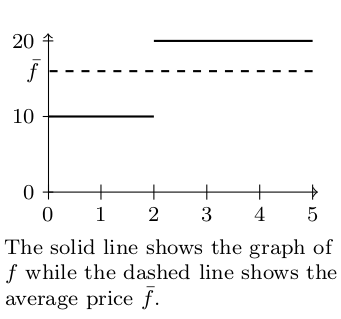
- The function $f(t) = \begin{cases}10 &0\leq t<2\\20&2\leq t\leq 5\end{cases}$ models the price of the stock for the 5-day period. The graph below shows both the function $f$ and the average stock price $\bar f$. Show that the area under $f$ for $0\leq t\leq 5$ is 80. Then show that the area under $\bar f$ for $0\leq t\leq 5$ is also 80.
- The average value of a function over an interval $ [a,b] $ is a constant value $\bar f$ so that the areas under both $f$ and $\bar f$ are equal, which means $\ds\int_a^b \bar f dx = \int_a^b f dx.$ Solve for $\bar f$ to show that $$\bar f = \dfrac{\ds\int_a^b f dx}{\ds\int_a^b dx}.$$
Let's examine one last averaging question, this time as it relates to a rover. If we know the mass and center-of-mass of each part of the rover, we can use weighted averages to combine these values and obtain the center-of-mass of the the entire rover.
- Consider a simplified rover with a bottom and a top.
- The bottom part of the rover has a volume of $V_1$ m$^3$, a constant density (mass per volume) of $\delta_1$ g/m$^3$, and a center-of-mass located at $(\bar x_1,\bar y_1,\bar z_1)$.
- The top part of the rover has a volume of $V_2$ m$^3$, a constant density (mass per volume) of $\delta_2$ g/m$^3$, and a center-of-mass located at $(\bar x_2,\bar y_2,\bar z_2)$.
- Give the masses $m_1$ and $m_2$ of the bottom and top of the rover. Explain.
- What proportion of the total mass comes from the bottom of the rover?
- Explain why the center-of-mass of the entire rover is $$\left(\frac{\bar x_1(m_1)+\bar x_2(m_2)}{m_1+m_2},\frac{\bar y_1(m_1)+\bar y_2(m_2)}{m_1+m_2}, \frac{\bar z_1(m_1)+\bar z_2(m_2)}{m_1+m_2}\right) .$$
- The rover picks up an additional object. The object's mass is $m_3$ with center-of-mass $(\bar x_3, \bar y_3, \bar z_3)$. Modify the formula above to give the center-of-mass of the rover, together with the new object. Try writing the formula using summation notation.
Task 26.2
To find the mass of a thin metal plate occupying a region $R$ in the $xy$-plane, we add up the little masses (differentials) $dm = \delta(x,y)dA$, where $\delta$ is the density (mass per area), to obtain the mass as $$m=\iint_R\delta(x,y)dA = \iint_R\delta(x,y) dxdy= \iint_R\delta(x,y) dydx. $$ Note that if $\delta(x,y)=1$, then this reduces to the formula for the area of $R$. This task has you practice setting up area and mass integrals.
For each region $R$ below, draw the region. Then set up an iterated double integral which would give the area of the region. Then use the density provided to set up an iterated double integral that would give the mass of a metal plate occupying this region with the given density. You do not need to compute each integral, rather just set it up.
- The region $R$ is above the line $x+y=1$ and inside the circle $x^2+y^2=1$. The density is $\delta(x,y)=x$.
- The region $R$ is below the line $y=8$, above the curve $y=x^2$, and to the right of the $y$-axis. The density is $\delta(x,y)=xy^2$.
- The region $R$ is bounded by $2x+y=3$, $y=x$, and $x=0$. The density is $\delta(x,y)=7$.
Task 26.3
Consider the change-of-coordinates $x=r\cos \theta$ and $y=r\sin\theta$.
- The lines $r=1,r=2,r=3$ and $\theta=0,\theta=\frac{\pi}{6},\theta=\frac{\pi}{3}$ correspond to circles and lines in the $xy$ plane. Draw these circles and lines in the $xy$-plane.
- The box in the $r\theta$ plane with $2\leq r\leq 3$ and $\frac{\pi}{6}\leq \theta\leq \frac{\pi}{3}$ corresponds to a region in the $xy$ plane. Shade this region in the $xy$ plane.
- Let $(r,\theta)$ be an arbitrary point. Our goal is to develop a formula for the area of the region $R$ in the $xy$ plane where the radius ranges from $r$ to $r+dr$ and the angle ranges from $\theta$ to $\theta +d\theta$, shown in the diagram below.
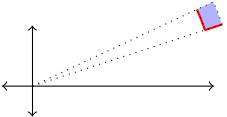
- Add the labels $r$, $\theta$, $dr$, $d\theta$, $r+dr$, and $\theta +d\theta$ to appropriate places in your diagram.
- The shaded region is approximately a rectangle. Letting the width of the rectangle be $dr$, explain why the height of the rectangle can be approximated by $rd\theta$. This means that a little area is give by $dA=rdrd\theta$.
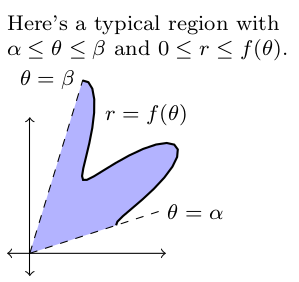
- Consider the region $R$ in the $xy$ plane bounded by $\alpha\leq \theta\leq \beta$ and $0\leq r\leq f(\theta)$ (shown below). The area of such a region $R$ in the $xy$ plane is the double integral $A=\int\int_R dA$. Explain why the area of the region in the $xy$ plane, when using polar coordinates, is $$A=\int_\alpha^\beta\int_0^{f(\theta)} rdrd\theta.$$
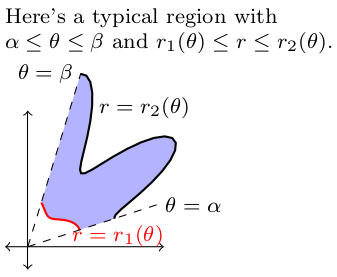
- Now consider the region $R$ bounded by $\alpha\leq \theta\leq \beta$ and $r_1(\theta)\leq r\leq r_2(\theta)$. Set up a double integral that would give the area of this region $R$.
Task 26.4
Pick some problems related to the topics we are discussing from the Text Book Practice page.
|
Sun |
Mon |
Tue |
Wed |
Thu |
Fri |
Sat |