
- I-Learn, Class Pictures, Learning Targets, Text Book Practice
- Prep Tasks: Unit 1 - Motion, Unit 2 - Derivatives, Unit 3 - Integration, Unit 4 - Vector Calculus
Day 5 - Prep
Task 5.1
Work is a transfer of energy. When a force acts through a displacement, work is done. Gravity acts on falling objects, transferring potential energy to kinetic energy. Any force, when acting through a displacement, will result work done.
- When a constant force and displacement are in the same straight line direction, the work done is simply the product of the magnitude of the force, and the distance.
- When a constant force acts opposite a straight line displacement, the work is the negative of the magnitude of the force and the distance.
If a constant force is not parallel (or antiparallel) to a straight line displacement $\vec d$, then we instead use the component of the force that is parallel to the displacement (so $\vec F_{\parallel \vec d}$) to compute work.
Let $\vec F=(-1,2)$ and $\vec d=(3,4)$.
- Start by computing $\vec F_{\parallel d} = \text{proj}_{\vec d}\vec F$ and $\vec F_{\perp d}$.
- Construct a picture that shows the relationship between $\vec F,$ $\vec d$, $\text{proj}_{\vec d}\vec F$, and $\vec F_{\perp d}$.
- Compute the work done by $\vec F$ through the displacement $\vec d$ by computing $|\vec F_{\parallel d}|$ and $|\vec d|$. Should the work be positive or negative?
Change the force to $\vec F = (-2,0)$. but keep $\vec d=(3,4)$.
- Construct a similar picture as above, showing the relationship between $\vec F,$ $\vec d$, $\text{proj}_{\vec d}\vec F$, and $\vec F_{\perp d}$. Feel free to construct this picture with, or without, doing any computations.
- Compute the work done by $\vec F$ through the displacment $\vec d$. Should the work be positive or negative?
- Can you find a simpler way to compute the work done by $\vec F$ through $\vec d$ than computing $|\vec F_{\parallel d}|$ and $|\vec d|$?
Task 5.2
- Find the length of the curve $\ds \vec r(t) = \left(t^3,\frac{3t^2}{2}\right)$ for $t\in[1,3]$. The notation $t\in[1,3]$ means $1\leq t\leq 3$. Be prepared to show us your integration steps in class (you'll need a substitution).
- Now find the length of the helix $\vec r(t) = (2\cos t, 2\sin t, t)$ for $t\in [0, 4\pi] $.
Task 5.3
Suppose a rover is currently moving and has a velocity vector $\vec v = (3,4)$. A force acts on the rover causing an acceleration of $\vec a = (-1,5)$. The rover is currently at the location $(2,-3)$.
- Draw picture that shows the rover's location along with the velocity and acceleration vectors drawn with their base at the rover's location.
- Find the vector component of the acceleration that is parallel to the velocity (so find $\vec a_{\parallel \vec v}$), and then find the vector component of the acceleration that is orthogonal to the velocity (so find $\vec a_{\perp \vec v}$).
- Will this acceleration cause the rover to speed up or slow down? Explain.
- Will this acceleration cause the rover to turn left or right? Explain.
A probe above Mars is currently moving and has a velocity vector $\vec v = (-2,1,2)$. The onboard thrusters apply a force that causes an acceleration of $\vec a = (0,2,-3)$.
- Find both $\vec a_{\parallel \vec v}$ and $\vec a_{\perp \vec v}$.
- Will this acceleration cause the satellite to speed up or slow down? Explain.
- How would you interpret $\vec a_{\perp \vec v}$?
Task 5.4
The last problem for prep each day will point to relevant problems from OpenStax. Spend 30 minutes working on problems from the sections below.
- Work: section 2.3, checkpoint 2.29 and exercises 175-179
- Projection: section 2.3, checkpoint 2.27 and exercises 167-172
- Arc Length: section 3.3: checkpoint 3.9, exercises 102-112
Day 5 - In class
Fang Face - 6D angle between vectors
How can we determine if cave markings on a wall were made with different materials?
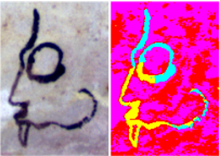
The image in the cave looks all black to the human eye. However, lots of materials look black when used. These cave markings, detailing a map of the surrounding area, could have been made all at once, or by different groups of people as more information was learned. Is there a way to determine if the materials used to make the map are all the same?
We use cameras designed to capture wave lengths that we can't see, and take 6 different snap shots (capturing different types of information). For each pixel in the picture, the cameras record six numbers. We can think of these numbers as 6D vectors, such as the 3 simplified vectors below.
- $\vec v_1 = (2, 1, 5, 3, 4, 2)$
- $\vec v_2 = (4, 2, 10, 6, 8, 4)$
- $\vec v_3 = (4, 2, 1, 3, 6, 5)$
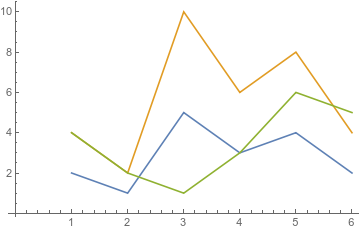
How do we recognize if two vectors represent the same material? First, the numbers can increase proportionally with brightness. Double the brightness, and the numbers coming back can double. So the same material may register as different vectors.
- Can you tell that $\vec v_2$ is twice $\vec v_1$?
We can use the law of cosines $$\vec u\cdot\vec v = |\vec u||\vec v|\cos\theta$$ to compute the angle between each six dimensional vector. The engineering team which worked on this project used a method called $k$-means clustering to group vectors together based off these angles, and determined that several different materials were used.
Brain Gains (Rapid Recall, Jivin' Generation)

- I'll draw two vectors $\vec F$ and $\vec d$. Draw the projection of $\vec F$ onto $\vec d$ (i.e. $\text{proj}_{\vec d}\vec F$).
Solution
We'll do this one together, and look at a visual solution using Mathematica and a file from I-Learn 215-Tech-Introduction.nb.
- When we write the sum $\vec F = \vec F_{\parallel \vec d}+ \vec F_{\perp \vec d}$, we call $\vec F_{\parallel \vec d}$ the ____ of $\vec F$ that is ____ to $\vec d$.
Solution
The (vector) component of $\vec F$ that is parallel to $\vec d$. Note that this vector is just the projection of $\vec F$ onto $\vec d$, so $\text{proj}_{\vec d}\vec F$.
The length of this vector is sometimes called the scalar component of $\vec F$ that is parallel to $\vec d$.
- What do we call $\vec F_{\perp \vec d}$.
Solution
The vector component of $\vec F$ that is orthogonal to $\vec d$.
- If $\vec F=(6,7)$ and $\vec F_{\parallel \vec d} = (2,-1)$, then what is $\vec F_{\perp \vec d}$?
Solution
Since $\vec F_{\parallel \vec d}$ and $\vec F_{\perp \vec d}$ must sum to $\vec F$, then $\vec F_{\perp \vec d} = \vec F - \vec F_{\parallel \vec d} = (6,7)-(2,-1) = (4,8)$.
Note that $\vec F_{\parallel \vec d} \cdot \vec F_{\perp \vec d}=0$, which should be the case (these two vectors are always orthogonal).
- If a force $\vec F$ of magnitude 10 N acts in the same direction as a displacement $\vec d$ of 5 m, what is the work done by $\vec F$ through the displacement $\vec d$?
Solution
The work done by $\vec F$ through $\vec d$ is the dot product $$\vec F\cdot \vec d = |\vec F||\vec d|\cos\theta = (10 N)(5 m)\cos 0 = 50 Nm.$$ This is one of the key application of the dot product.
Note that when the direction of the force and displacement are the same, then $\cos \theta = 1$, which gives the work as simply $W = |\vec F||\vec d|$. This is the most common introductory explanation in a physics course. In general, we have $$W = |\vec F||\vec d|\cos \theta = \vec F\cdot \vec d.$$ The dot product was created around 1900, with one benefit being that it simplifies work computations, precisely when the force and displacement are NOT in the same direction.
- The force $\vec F = (3,5)$ N acts on an object which undergoes a displacement $(-2,1)$ m. Find the work done by $\vec F$ though this displacement.
Solution
Work is given as the dot product of $\vec F$ and $\vec d$. Thus, $W=(3,5)\cdot(-2,1)=-6+5=-1$ Nm .
- Recall the arc length formula is $$\int_C ds = \int_a^b\left|\dfrac{d\vec r}{dt}\right|dt=\int_a^b\sqrt{\left(\frac{dx}{dt}\right)^2+\left(\frac{dy}{dt}\right)^2}dt.$$ Set up an integral to find the arc length of the curve $\vec r(t) = (t^2, t^3)$ for $t\in [-1,3] $.
Answer:
The derivative (velocity) is $\vec v(t) =(2t,3t^2)$. The magnitude of the derivative (speed) is $v = |\vec v| = \sqrt{(2t)^2+(3t^2)^2}$. A little bit of distance is equal to the speed multiplied by a little bit of time, or $$ds = \sqrt{(2t)^2+(3t^2)^2}dt.$$ Summing this over the time values for $t\in [-1,3] $ gives the total distance as $$s = \int_C ds = \int_{-1}^{3}\sqrt{(2t)^2+(3t^2)^2}dt.$$
Group Problems
Remember to Pass the Chalk after each part of each problem.
- Let $\vec F=(-10,0)$ N and $\vec d=(2,1)$ m. Recall the projection of $\vec F$ onto $\vec d$ is $\ds \text{proj}_\vec d\vec F = \frac{\vec F\cdot \vec d}{\vec d\cdot \vec d}\vec d$.
- How much work is done by $\vec F$ through the displacement $\vec d$? (Yes, just compute the dot product of the two vectors).
- Compute the projection of $\vec F$ onto $\vec d$ (so compute $\vec F_{\parallel \vec d}$).
- Draw $\vec F$, $\vec d$ and $\text{proj}_\vec d\vec F $ on the same grid, all with their base at the origin. Try your best to give the $x$ and $y$ directions the same scale, otherwise you won't be able to see the connections among vectors.
- Add to your picture the vector difference $\vec F_{\perp \vec d}=\vec F - \text{proj}_\vec d\vec F $. Which vectors in your picture are orthogonal?
- Draw $\text{proj}_\vec F\vec d $, without doing any computations. Have each group member do this, and discuss any differences.
- Consider the curve $C$ parametrized by $\vec r(t) = (3-2t^2,4t+5)$ for $-1\leq t\leq 3$.
- Give a vector equation of the tangent line to the curve at $t=2$.
- Recall the arc length formula is $$\int_C ds = \int_a^b\left|\dfrac{d\vec r}{dt}\right|dt=\int_a^b\sqrt{\left(\frac{dx}{dt}\right)^2+\left(\frac{dy}{dt}\right)^2}dt.$$ Set up a formula to compute the length of this curve. Just set it up.
- Consider the curve $C$ parametrized by $\vec r(t) = (t^2, t^3)$ for $0\leq t\leq 2$.
- Give a vector equation of the tangent line to the curve at $t=1$. PTC
- Find the length of this curve. Actually compute the integral.
Day 6 - Prep
Task 6.1
We can generalize what we've done to find the work done by any force (doesn't have to be constant), acting on any object, along any path. Recall that work is a transfer of energy. Consider the following examples:
- A tornado picks up a couch and applies forces to the couch as it swirls around the center. Work is the transfer of the energy from the tornado to the couch, giving the couch its kinetic energy.
- When an object falls, gravity does work on the object. The work done by gravity converts potential energy to kinetic energy.
- If we consider the flow of water down a river, it is gravity that gives the water its kinetic energy. We can place a hydroelectric dam next to a river to capture a lot of this kinetic energy. Work transfers the kinetic energy of the river to rotational energy of the turbine, which eventually ends up as electrical energy available in our homes.
When we study work, we are really studying how energy is transferred. This is one of the key components of modern life. Recall that the work done by a vector field $\vec F$ through a displacement $\vec d$ is the dot product $\vec F\cdot \vec d$.
- When object moves from $A=(6,0)$ to $B=(0,3)$ encountering the constant force $\vec F = (2,5)$, the work is done by $\vec F$ as the object moves from $A$ to $B$ is simply the displacement $B-A=(-6,3)$ dotted by the force, so we have $W = \vec F\cdot \vec d = (2,5)\cdot(-6,3) = -12+15=3$.
An object moves from $A=(6,0)$ to $B=(0,4)$. A parametrization of the object's path is $\vec r(t) = (-3,2)t+(6,0)$ for $0\leq t\leq 2$.
- For $0\leq t\leq 1$, the force encountered is $\vec F = (2,5)$. For $1\leq t\leq 2$, the force encountered is $(2,7)$. How much work is done in the first second? How much work is done in the last second? How much total work is done?
- If we encounter a constant force $\vec F$ over a little displacement $d\vec r$, explain why the little work done is $\ds dW = \vec F\cdot d\vec r =\vec F\cdot \frac{d\vec r}{dt}dt $.
- Suppose that the force constantly changes as we move along the curve. At $t$, we encountered the force $\vec F(t) = (2,5+2t)$, which we could think of as the wind blowing stronger and stronger to the north. Explain why the total work done by this force along the path is $$\ds W=\int \vec F\cdot d\vec r = \int_0^2 (2,5+2t)\cdot (-3,2)dt.$$ Then compute this integral and show you get 16.
- If you are familiar with the units of energy, complete the following. What are the units of $\vec F$, $d\vec r$, and $dW$.
If a force of magnitude $F$ acts through a displacement with magnitude $d$, then the most basic definition of work is $W=Fd$, the product of the force and the displacement. Recall that this basic definition has a few assumptions.
- The force $F$ must act in the same direction as the displacement.
- The force $F$ must be constant throughout the displacement.
- The displacement must be in a straight line.
The dot product let's us remove the first assumption as work is $W=\vec F\cdot \vec r,$ where $\vec F$ is a force acting through a displacement $\vec r$. We just saw we can remove the assumption that $\vec F$ is constant to obtain $$W=\int \vec F \cdot d\vec r = \int_a^b F\cdot \frac{d\vec r}{dt}dt, $$ provided we have a parametrization of $\vec r$ with $a\leq t\leq b$. We now get rid of the assumption that $\vec r$ is a straight line.
- Suppose that we move along the circle $C$ parametrized by $\vec r(t) = (3\cos t,3\sin t)$. As we move along $C$, we encounter a rotational force $\vec F(x,y) = (-2y,2x)$.
- Draw $C$. Then at several points on the curve, draw the vector field $\vec F(x,y)$. For example, at the point $(3,0)$ you should have the vector $\vec F(3,0)=(-2(0),2(3))=(0,6)$, a vector sticking straight up 6 units. Are we moving with the vector field, or against the vector field?
- Explain why we can state that a little bit of work done by a force $\vec F$ over a small displacement $d\vec r$ is $dW = \vec F\cdot d\vec r$. Why does it not matter that $\vec r$ does not move in a straight line?
- Since a little work done by $\vec F$ along $d\vec r$ (a small bit of $C$) is $dW = \vec F\cdot d\vec r$, we know that the total work done is $\int dW = \int \vec F\cdot d\vec r$. This gives us $$W = \int_C\left(-2y,2x\right)\cdot d\vec r = \int_0^{2\pi}\left(-2(3\sin t),2(3\cos t)\right)\cdot(-3\sin t, 3\cos t)dt.$$ Complete the integral, showing that the work done by $\vec F$ along $C$ is $36\pi$.
$$W = \int_C \vec F\cdot d\vec r= \int_a^b \vec F(\vec r(t))\cdot \frac{d\vec r}{dt}dt.$$ Note that we put the $C$ under the integral $\int_C$ to remind us that we are integrating along the curve $C$. This means we need to get a parametrization of the curve $C$, and give bounds before we can integrate with respect to $t$.
If we let $\vec F = (M,N)$ and we let $\vec r(t)=(x,y)$, so that $d\vec r = (dx,dy)$, then we can write work in the differential form $$W = \int_C \vec F\cdot d\vec r= \int_C (M,N)\cdot (dx,dy) = \int_C Mdx+Ndy.$$
Task 6.2
Suppose an object travels along the path given by $\vec r(t) = (3t,-2t^2)$. The velocity is $\vec v(t) = (3,-4t)$ and the acceleration is $\vec a(t)=(0,-4)$.
- Is there a time $t$ at which the velocity and acceleration vectors are parallel? Explain.
- Compute the vector component of the acceleration vector that is parallel to the velocity vector. In other words, compute $\text{proj}_{\vec v}\vec a$. We'll call this vector $\vec a_{\parallel \vec v}$.
- What is the vector component of the acceleration vector that is orthogonal to the velocity vector? We'll call this vector $\vec a_{\perp \vec v}$.
- Draw a picture that shows the relationship among $\vec v$, $\vec a$, $\vec a_{\parallel \vec v}$, and $\vec a_{\perp \vec v}$.
Task 6.3
As the semester goes, we'll be learning to use Mathematica. You can install Mathematica for free as BYU-I student (see here to obtain Mathematica if you do not already have it). If you've never used Mathematica before, no worries. Here is Fast Introduction to Mathematica for Math Students. After reading the "Entering Input" section, feel free to click on the tabs on the left for more information about any topic needed.
- Let's write a block of code in Mathematica to compute the arc length of any parameterized curve.
- First, define a vector function in Mathematica to represent the parameterized curve $\ds \vec r(t) = \left(t^3,\frac{3t^2}{2}\right)$. Something like r = {t^3,3t^2/2}.
- Define some variables to hold the upper and lower limits for the parameter $t$ (something like a=1 and b=3).
- Add a line to your block of code that uses ParametricPlot[] to create a graph of the function. This verifies that the function is defined correctly.
- Compute the derivative or $\vec r$ using the derivative command ( D[]).
- Compute the length of the derivative using the Norm[] command.
- Compute the arc length of the curve using the Integrate[] command. You can use the N[] command to get a decimal approximation.
- Try putting all of the commands above into a single block of code, so that you can run it all with one execution.
- Copy the block of code that you created, then change the interval of integration to $2\leq t\leq 5$, and see if the plot as well as arc length update.
- Let's now use the work above to examine arc length for a few other curves. For each curve below, set up an integral formula which would give the length. Then sketch the curve. Try using them in the program you wrote above. Do not worry about integrating them by hand (they will get ugly really fast, and some are impossible).
- The parabola $\vec r(t) = (t,t^2)$ for $t\in[0,3]$.
- The ellipse $\vec r(t) = (4\cos t,5\sin t)$ for $t\in[0,2\pi]$.
- The hyperbola $\vec r(t) = (\tan t,\sec t)$ for $t\in[-\pi/ 4,\pi/4]$.
Task 6.4
The last problem for prep each day will point to relevant problems from OpenStax. Spend 30 minutes working on problems from the sections below.
- Work on paths (line integrals): section 2.3, checkpoint 6.18, example 6.23 and exercises 49-54
- Return to any of the previous day's OpenStax problems to locate extra practice.
|
Sun |
Mon |
Tue |
Wed |
Thu |
Fri |
Sat |