
- I-Learn, Class Pictures, Learning Targets, Text Book Practice
- Prep Tasks: Unit 1 - Motion, Unit 2 - Derivatives, Unit 3 - Integration, Unit 4 - Vector Calculus
Day 4 - Prep
Task 4.1
Consider the curve $\vec r(t) = (2t+3, 4(2t-1)^2)$.
- Construct a graph of $\vec r$ for $0\leq t\leq 2$.
- If this curve represents the path of a rover (meters for distance, minutes for time), find the velocity of the rover at any time $t$, and then specifically at $t=1$. What is the rover's speed at $t=1$?
- Give a vector equation of the tangent line to $\vec r$ at $t=1$. Include this on your graph.
- State the rover's acceleration vector.
- Explain how to obtain the slope of the tangent line, and then write an equation of the tangent line using point-slope form. [Hint: How can you turn the direction vector, which involves $(dx/dt)$ and $(dy/dt)$, into the number given by the slope $(dy/dx)$?]
Task 4.2
We are ready to tackle the problem of finding the length of a path. This length we call arc length. If a rover moves at a constant speed, then the distance traveled is simply $$\text{distance} = \text{speed}\times\text{time}.$$ This requires that the speed be constant. What if the speed is not constant? Over a really small time interval $dt$, the speed is almost constant, so we can still use the idea above.
Suppose a rover (or other object) moves along the path given by $\vec r(t)=(x(t),y(t))$ for $a\leq t\leq b$. We know that the velocity is $\dfrac{d\vec r}{dt}$, and so the speed is just the magnitude of this vector.
- Show that we can write the rover's speed at any time $t$ as $$\ds\sqrt{\left(\frac{dx}{dt}\right)^2+\left(\frac{dy}{dt}\right)^2}.$$
- If the rover moves at speed $\ds\sqrt{\left(\frac{dx}{dt}\right)^2+\left(\frac{dy}{dt}\right)^2}$ for a little time length $dt$, what's the little distance $ds$ that the rover traveled?
- Explain (Riemann sums may help) why the length of the path given by $\vec r(t)$ for $a\leq t\leq b$ is $$s=\int ds=\int_a^b \left|\frac{d\vec r}{dt}\right| dt=\int_a^b \sqrt{\left(\frac{dx}{dt}\right)^2+\left(\frac{dy}{dt}\right)^2}dt.$$
- The path $\vec r(t) = (3\cos t, 3\sin t)$ for $0\leq t\leq 2\pi$ is a circle of radius 3. Verify that the formula above does in fact yield the circumference of this circle.
- If the curve is in space (so $\vec r(t)=(x(t),y(t),z(t))$ is the path), then how does the arc length formula above change?
- Are there any requirements we must know about the parametrization $\vec r$ so that the formula above is valid?
Task 4.3
Gravity is often the first example we encounter of a vector field. Other important vector fields arise when we study magnetism, electricity, fluid flow, and more. To analyze how a river flows, we can construct a plot of the river and at each point in the river we draw a vector that represents the velocity at that point. This creates a collection of many vectors drawn all at once, where the base of each velocity vector is placed at the point where the velocity occurs. For gravity, a similar picture can be drawn, though all the vectors will point down with the same magnitude. This task has us construct a plot of a vector field.
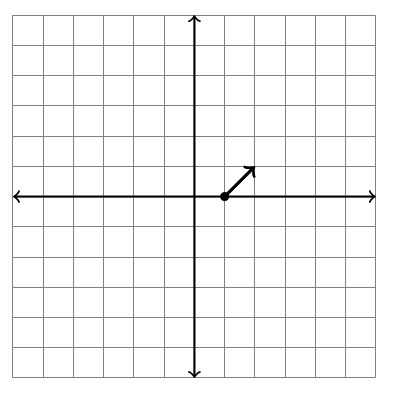
Consider the function $\vec F(x,y) = \left<x-2y,x+y\right>$. This is a function where the input is a point $(x,y)$ in the plane, and the output is the vector $\left<x-2y,x+y\right>$. For example, if we input the point $(1,0)$, then the output is $\left<1-2(0),1+0\right> = \left<1,1\right>$. To construct a vector field plot, we draw the vector $\left<1,1\right>$ with its base located at the input $(1,0)$. In the picture below, based at $(1,0)$ we draw a vector that points right 1 and up 1.
- Complete the table below and add the other 7 vectors to the graph.
\(\begin{array}{c|c} (x,y)&\left<x-2y,x+y\right>\\\hline (1,0)&\left<1,1\right>\\ (1,1)&\\ (1,-1)&\\ (0,1)&\\ (0,-1)&\\ (-1,0)&\\ (-1,1)&\\ (-1,-1)& \end{array}\)
- Repeat the above for the vector field $\vec F(x,y)=(-2y,3x)$, constructing a vector field plot consisting of 8 vectors.
Task 4.4
The last problem for prep each day will point to relevant problems from OpenStax. Spend 30 minutes working on problems from the sections below.
- section 3.2: checkpoint 3.7, exercises 75-92
- Arc Length Practice: section 3.3: checkpoint 3.9, exercises 102-112
Day 4 - In class
Brain Gains (Rapid Recall, Jivin' Generation)

- A rover follows the path given by $\vec r(t) = (3t,t^2)$. Find the velocity of the rover at $t=2$.
- Give a vector equation of the tangent line to the rover's path at $t=2$, so $$\begin{pmatrix}x\\y\end{pmatrix} = \begin{pmatrix}?\\?\end{pmatrix} t+\begin{pmatrix}?\\?\end{pmatrix}.$$
- Give the rover's speed at any time $t$.
- An object travels along straight lines. Its velocity is $ (0,3,4) $ m/s for 2 seconds, and then turns so its velocity is $ (1,2,-2) $ m/s for 5 seconds. Show the total distance (arc length) traveled by the object is 25m. [Hint: find the speed from the velocity.]
Group Problems
- Find the arc length of the curve $\vec r(t) = (t^2, t^3)$ for $0\leq t\leq 2$. Recall the arc length formula is $$\int_C ds = \int_a^b\sqrt{\left(\frac{dx}{dt}\right)^2+\left(\frac{dy}{dt}\right)^2}dt.$$ Actually compute any integrals you encounter.
- Draw the vector field $\vec F(x,y) = \langle2x+y,x+2y\rangle$. (Based at $(x,y)$, draw the vector $\langle2x+y,x+2y\rangle$.)
- Draw the vector field $\vec F(x,y) = \langle y,-x\rangle$.
- Draw $\vec r(t) = (3 \cos t, 3 \sin t)$.
- The curve above represents the position of an object. Compute the velocity of the object, so $\vec v(t) = \frac{d\vec r}{dt}$.
- State the speed of the object above (simplify your answer to get a speed of 3). What is the difference between velocity and speed?
- Draw $\vec r(t) = (3 \cos 2t, 3 \sin 2t)$. (Suggestion - use multiples of $\pi/4$ for a table, rather than $\pi/2$. Why?) What is the speed of this curve? (Simplify the speed to get 6.)
- Draw $\vec r(t) = (7 \cos 5t, 7 \sin 5t)$. What is the speed of this curve? (Did you get 35?)
- Hurricane Matthew has a diameter of 28 miles. Assuming the eye is at the origin $(0,0)$, give a parametrization of the exterior edge of the hurricane.
- Sustained winds are 128 mi/hr. Modify your parametrization above so that the speed is 128 mi/hr.
- The eye of the hurricane is moving north west at a speed of 12 mi/hr. Modify your parametrization so that the center moves north west at 12 mi/hr.
- Let $\vec F=(-10,0)$ N and $\vec d=(2,1)$ m. Recall the projection of $\vec F$ onto $\vec d$ is $\ds \text{proj}_\vec d\vec F = \frac{\vec F\cdot \vec d}{\vec d\cdot \vec d}\vec d$.
- Compute the projection of $\vec F$ onto $\vec d$ (so compute $\vec F_{\parallel \vec d}$).
- Draw $\vec F$, $\vec d$ and $\text{proj}_\vec d\vec F $ on the same grid, all with their base at the origin. Try your best to give the $x$ and $y$ directions the same scale, otherwise you won't be able to see the connections among vectors.
- Add to your picture the vector difference $\vec F_{\perp \vec d}=\vec F - \text{proj}_\vec d\vec F $. Which vectors in your picture are orthogonal?
- Draw $\text{proj}_\vec F\vec d $, without doing any computations. Have each group member do this, and discuss any differences.
Day 5 - Prep
Task 5.1
Work is a transfer of energy. When a force acts through a displacement, work is done. Gravity acts on falling objects, transferring potential energy to kinetic energy. Any force, when acting through a displacement, will result work done.
- When a constant force and displacement are in the same straight line direction, the work done is simply the product of the magnitude of the force, and the distance.
- When a constant force acts opposite a straight line displacement, the work is the negative of the magnitude of the force and the distance.
If a constant force is not parallel (or antiparallel) to a straight line displacement $\vec d$, then we instead use the component of the force that is parallel to the displacement (so $\vec F_{\parallel \vec d}$) to compute work.
Let $\vec F=(-1,2)$ and $\vec d=(3,4)$.
- Start by computing $\vec F_{\parallel d} = \text{proj}_{\vec d}\vec F$ and $\vec F_{\perp d}$.
- Construct a picture that shows the relationship between $\vec F,$ $\vec d$, $\text{proj}_{\vec d}\vec F$, and $\vec F_{\perp d}$.
- Compute the work done by $\vec F$ through the displacement $\vec d$ by computing $|\vec F_{\parallel d}|$ and $|\vec d|$. Should the work be positive or negative?
Change the force to $\vec F = (-2,0)$. but keep $\vec d=(3,4)$.
- Construct a similar picture as above, showing the relationship between $\vec F,$ $\vec d$, $\text{proj}_{\vec d}\vec F$, and $\vec F_{\perp d}$. Feel free to construct this picture with, or without, doing any computations.
- Compute the work done by $\vec F$ through the displacment $\vec d$. Should the work be positive or negative?
- Can you find a simpler way to compute the work done by $\vec F$ through $\vec d$ than computing $|\vec F_{\parallel d}|$ and $|\vec d|$?
Task 5.2
- Find the length of the curve $\ds \vec r(t) = \left(t^3,\frac{3t^2}{2}\right)$ for $t\in[1,3]$. The notation $t\in[1,3]$ means $1\leq t\leq 3$. Be prepared to show us your integration steps in class (you'll need a substitution).
- Now find the length of the helix $\vec r(t) = (2\cos t, 2\sin t, t)$ for $t\in [0, 4\pi] $.
Task 5.3
Suppose a rover is currently moving and has a velocity vector $\vec v = (3,4)$. A force acts on the rover causing an acceleration of $\vec a = (-1,5)$. The rover is currently at the location $(2,-3)$.
- Draw picture that shows the rover's location along with the velocity and acceleration vectors drawn with their base at the rover's location.
- Find the vector component of the acceleration that is parallel to the velocity (so find $\vec a_{\parallel \vec v}$), and then find the vector component of the acceleration that is orthogonal to the velocity (so find $\vec a_{\perp \vec v}$).
- Will this acceleration cause the rover to speed up or slow down? Explain.
- Will this acceleration cause the rover to turn left or right? Explain.
A probe above Mars is currently moving and has a velocity vector $\vec v = (-2,1,2)$. The onboard thrusters apply a force that causes an acceleration of $\vec a = (0,2,-3)$.
- Find both $\vec a_{\parallel \vec v}$ and $\vec a_{\perp \vec v}$.
- Will this acceleration cause the satellite to speed up or slow down? Explain.
- How would you interpret $\vec a_{\perp \vec v}$?
Task 5.4
The last problem for prep each day will point to relevant problems from OpenStax. Spend 30 minutes working on problems from the sections below.
- Work: section 2.3, checkpoint 2.29 and exercises 175-179
- Projection: section 2.3, checkpoint 2.27 and exercises 167-172
- Arc Length: section 3.3: checkpoint 3.9, exercises 102-112
|
Sun |
Mon |
Tue |
Wed |
Thu |
Fri |
Sat |