
During Class
Brain Gains
Definition: Partial Derivative
Consider a function of several variables $f(x,y)$.
- The symbol $\frac{\partial f}{\partial x}$ is read "the partial derivative of $f$ with respect to $x$" or "the partial of $f$ with respect to $x$".
- The symbol $\frac{\partial f}{\partial y}$ is read "the partial derivative of $f$ with respect to $y$" or "the partial of $f$ with respect to $y$".
To calculate a partial derivative we treat all independent variables, except the one we are differentiating with respect to, as constants and use the derivative rules for a single variable function.
Let's look at an example that includes the chain rule. Consider the function $S(x,y) = 3(\pi x + 4y)^3$.
- The partial of $S$ with respect to $x$ is $\frac{\partial S}{\partial x} = 3(3(\pi x + 4y)^{2})(\pi)$.
- And the partial of $S$ with respect to $y$ is $\frac{\partial S}{\partial y} = 3(3(\pi x + 4y)^{2})(4)$.
1. For the function $g(x) = e^{3x^2}$, identify two functions $f(u)$ and $u(x)$ so that $g(x) = f(u(x))$. Then compute $\frac{dg}{dx} = \frac{df}{du}\frac{du}{dx}$.
2. Use the information about $f$ and $f'$ in the table and $g$ to find each of the following values.
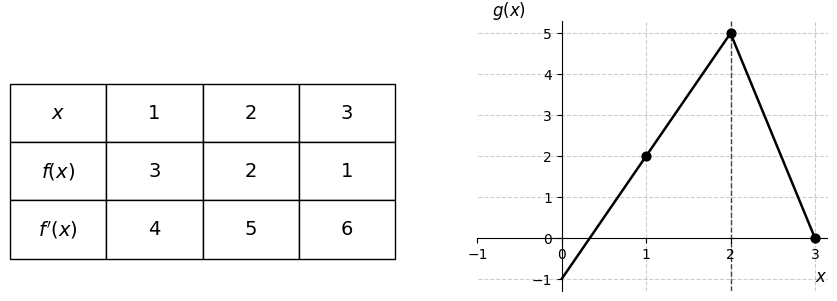
- Given $h(x) = g(f(x))$, find $h'(3)$.
- Given $k(x) = f(g(x))$, find $k'(1)$.
Solution
Each of these problems focus on using the chain rule. We will use $g(1) = 2$ and $g'(1)=3$ (slope of the line).
- We have $h'(x) = g'(f(x))f'(x)$, which means $h'(3) = g'(f(3))f'(3) = g'(1)(6) = (3)(6) = 18$.
- We get $k'(x) = f'(g(x))g'(x)$, and so $k'(1) = f'(g(1))g'(1) = f'(2)(3) = (5)(3) = 15$.
3. Given $f(a; \textbf{x}) = \sum_{i=1}^{3} (ax_i + 2)^5$, find $\frac{df}{da}$.
Answer
We see $\frac{df}{da} = 5x_1(ax_1 + 2)^4 + 5x_2(ax_2 + 2)^4 + 5x_3(ax_3 + 2)^4 = \sum_{i=1}^3 5x_i(ax_i + 2)^4$.
4. For the function $f(x) = e^{3x}$ and $g(x) = x^4 - 1$, write out both $f(g(x))$ and $g(f(x))$, and then compute the derivative of each composite function.
Solution
The composite functions are
- $f(g(x)) = e^{3(x^4 - 1)}$ and
- $g(f(x)) = (e^{3x})^4 - 1$.
The derivatives of $f$ and $g$ are $f'(x) = 3e^{3x}$ and $g'(x) = 4x^3$. The chain rule then gives us
- $\ds\frac{d}{dx}[f(g(x))] = f'(g(x))g'(x) = 3e^{3(g(x))}4x^3 = 3e^{3(x^4 - 1)}4x^3.$
- $\ds\frac{d}{dx}[g(f(x))] = g'(f(x))f'(x) = 4(f(x))^33e^{3x} = 4(e^{3x})^33e^{3x}.$
Group Meeting
Start by giving each person a moment to share what they chose to prepare for class. Help each other address any questions. When each person has had a chance to share, move on the other activities.
Activity - Chain Rule Practice
For each function $g(x)$, identify two functions $f(u)$ and $u(x)$ so that $g(x) = f(u(x))$ and then compute $\frac{dg}{dx} = \frac{df}{du}\frac{du}{dx}$.
- $g(x) = (x^2-3)^4$
- $g(x) = \ln(4x+3)$
- $g(x) = e^{4x+3}$
- $g(x) = (x^3+\ln x)^2$
- $g(x) = \ln (e^{2x} + 1)$
- $g(x) = e^{4\ln{5x}+3}$
Activity - Partial Derivatives with the Chain Rule
- Given $S(x, y; a, b) = 3(ax + by)^{-3}$, find $\diff{S}{x}$ assuming all other variables and parameters are constant then find $\diff{S}{y}$ assuming all other variables and parameters are constant. (Yes, these are long-winded ways of saying compute $\frac{\partial S}{\partial x}$ and $\frac{\partial S}{\partial y}$.)
- Given $g(a_1, a_2; \textbf{x},\textbf{y}) = \sum_{i=1}^{7} \sqrt{a_1x_i + a_2y_i}$, find $\frac{\partial g}{\partial a_1}$ and $\frac{\partial g}{\partial a_2}$.
- Given $h(x, y; \textbf{a}, \textbf{b}) = \sum_{i=1}^{21} 3(a_ix + b_iy)^{-3}$, find $\frac{\partial h}{\partial x}$ and $\frac{\partial h}{\partial y}$.
Answer
- We have $\frac{\partial S}{\partial x}(x, y; a, b) = -9a(ax + by)^{-4}$ and $\frac{\partial S}{\partial y}(x, y; a, b) = -9b(ax + by)^{-4}$.
- We find $\frac{\partial g}{\partial a_1} = \sum_{i=1}^7 \frac{x_i}{2\sqrt{a_1x_i + a_2y_i}}$ and $\frac{\partial g}{\partial a_2} = \sum_{i=1}^7 \frac{y_i}{2\sqrt{a_1x_i + a_2y_i}}$.
- We compute $\frac{\partial h}{\partial x} = \sum_{i=1}^{21} -9a_i(a_ix + b_iy)^{-4}$ and $\frac{\partial h}{\partial y} = \sum_{i=1}^{21} -9b_i(a_ix + b_iy)^{-4}$
Activity - Graphing a Second Derivative
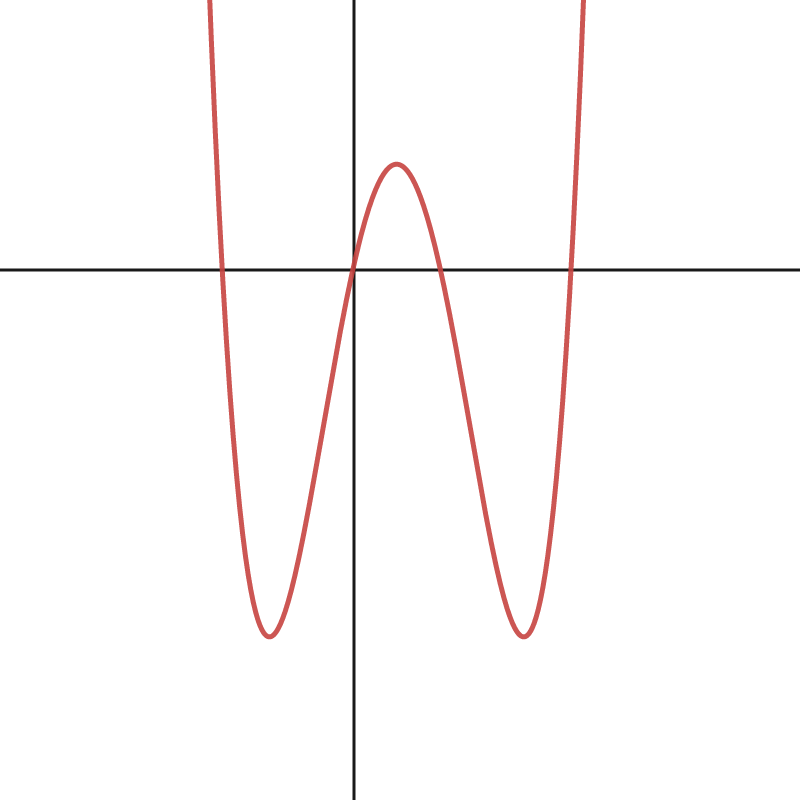
For the function below, graph the first and second derivative.
Solution
See Desmos.
Activity - Loglikelihood
You have been given a list of 44 data points, $(t_i, y_i)$, were $t_i$ is the time in hours since the light was turned on and $y_i$ is the percent intensity of the bulb after $t_i$ hours. A model for the percent intensity of the bulb is $f(x;m,b) = mx+b$, where $t$ is the time in hours since the light was turned on.
- Write the formula for the residuals.
Assume the residuals (errors) are independent and normally distributed (with mean of 0 and standard deviation of 1).
- Write down the probability model we are using for one of the residuals.
- What does knowing the residuals are independent allow us to do?
- Use the assumption of independent residuals to write the joint probability function.
- Write the likelihood function for the residuals in this situation.
- Write the loglikelihood function for the errors in this situation.
- Rewrite the loglikelihood function using the properties of logs and sums.
Activity - Chain Rule Practice
For each pair of functions $f(x)$ and $g(x)$ below, write out the compositions $f(g(x))$ and $g(f(x))$. Then compute the derivative of each composite function. As a suggestion, compute both $f'(x)$ and $g'(x)$ first, and then show how you can combine $f,g,f',g'$ to get the derivative of each composite function. Remember to pass the chalk between each problem.
- $f(x) = 3x + 4$, $g(x) = x^2 + 1$
- $f(x) = e^x$, $g(x) = \sqrt{2x-5}$
- $f(x) = \frac{1}{x}$, $g(x) = 2\ln(x)$
- $f(x) = (x-5)^4$, $g(x) = \sqrt[3]{x^2}$
- $f(x) = e^{3x}$, $g(x) = x^4 - 1$
- $f(x) = \frac{x}{x-3}$, $g(x) = \ln(5x)$
- $f(x) = 2x^3 - 10x^2 + 2x$, $g(x) = \sqrt{\frac{x-4}{2}}$
- $f(x) = \frac{1}{x^5}$, $g(x) = 4e^x$
- $f(x) = \sqrt{8-x}$, $g(x) = (2x-1)(x+5)$
- $f(x) = e^{x/2}$, $g(x) = 5x^3$
- $f(x) = 1 - \frac{3}{x^4}$, $g(x) = 2 - \sqrt{x}$
- $f(x) = \frac{3}{x^2}$, $g(x) = \ln(x)$
- $f(x) = 27 - x^3$, $g(x) = x^2 - x - 12$
- $f(x) = \sqrt[3]{4-x^2}$, $g(x) = 5x + 7$
- $f(x) = \frac{x+1}{x-2}$, $g(x) = e^{-x}$