
Brain Gains (Rapid Recall, Jivin' Generation)

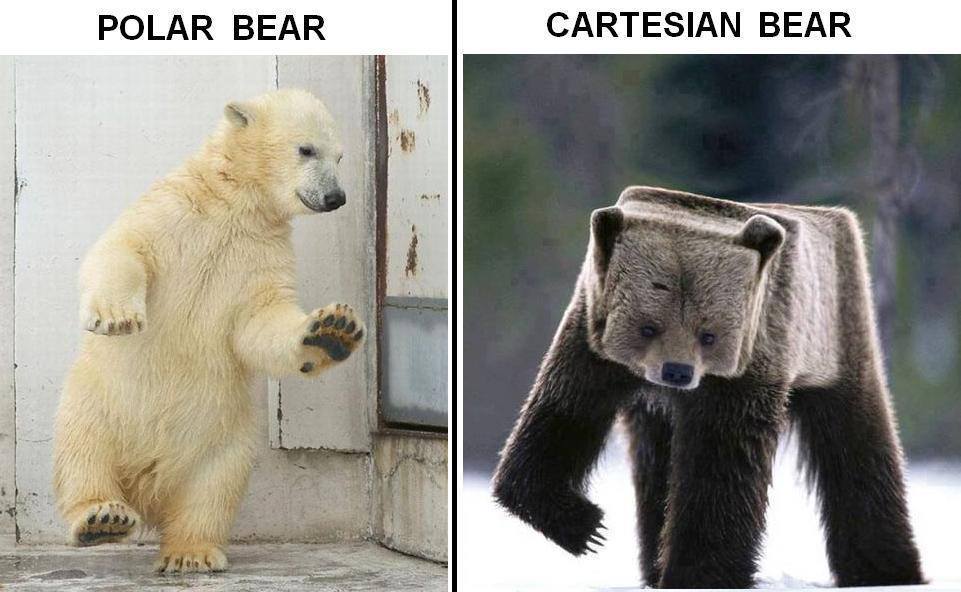
Draw a bear in polar coordinates, and then Cartesian coordinates.
- Draw a bear in polar coordinates, and then Cartesian coordinates.....
- Two objects lie on the $x$-axis. The first object has a mass of 2 kg and is located at the point $x=-1$ (or rather its center of mass is at that point). The second object has a mass of 3 kg and is located at the point $x=4$. Find the center-of-mass of the combined system.
Solution
The center of mass should be close to 4 than -1, because there is more mass there. There are many ways to do this problem. One way involves thinking of the 2kg object as 2 single kg objects, and the 3 kg object as 3 single kg objects. This means there are 5 equally weighted objects. We then average the $x$ coordinates of the 4 objects to get $$\bar x = \frac{(-1)+(-1)+4+4+4}{5} = \frac{(-1)2+(4)3}{2+3} = \frac{10}{5}=2.$$ Note that $\bar x = 2$ is closer to 4 than -1, as expected.
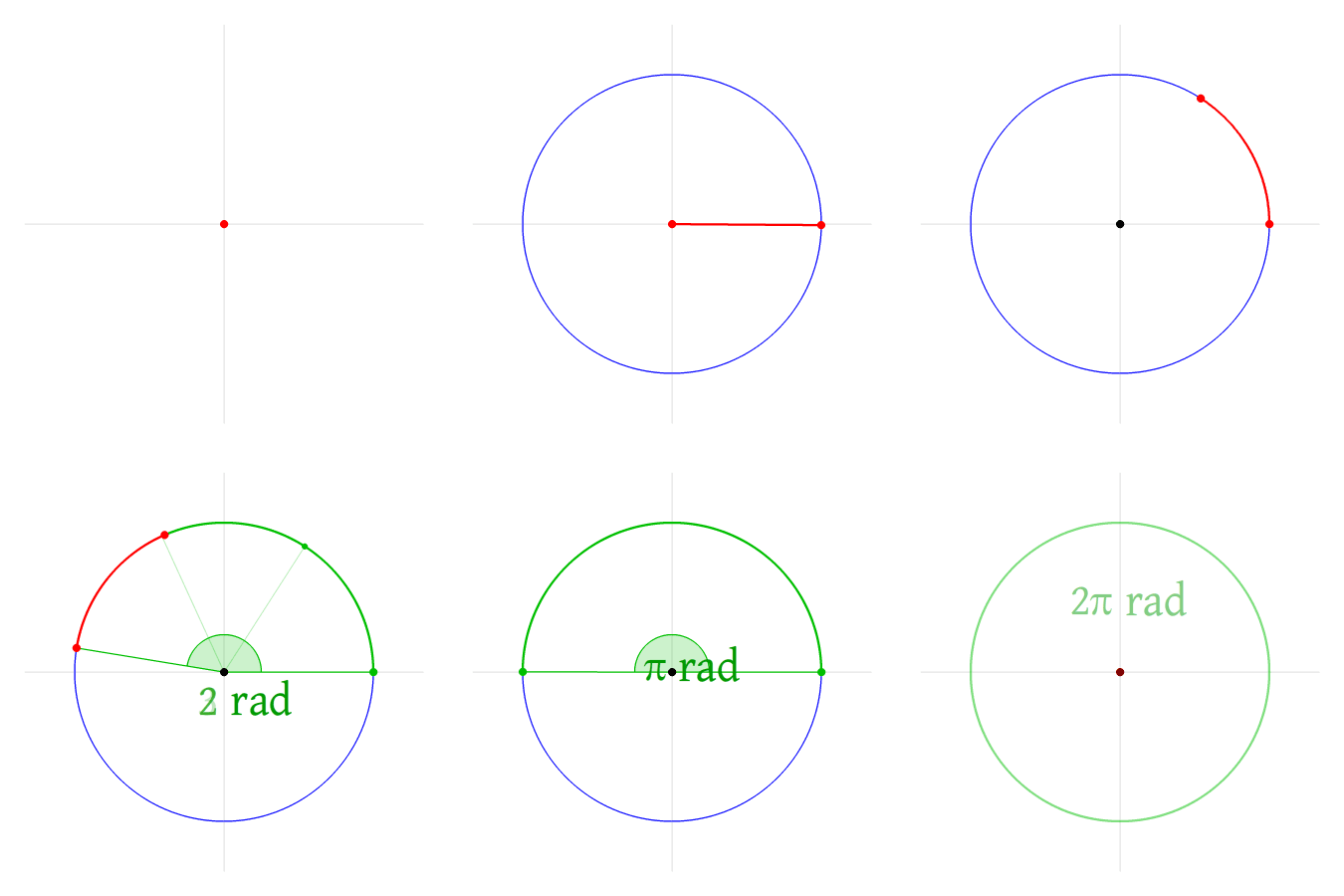
- If we travel $2\pi$ units along the outer edge of a disc of radius 6 units, then through what central angle, in radians, did we traverse?
Solution
The definition of radian measure is given by $$\text{radian measure} = \frac{\text{arc length}}{\text{radius of circle}}\quad \text{or}\quad \theta = \frac{s}{r}.$$ We've traveled (arc length) $s=2\pi$ units along a circle with radius $r=6$. The radian measure is $$\theta = \frac{s}{r} = \frac{2\pi}{6} = \frac{\pi}{3}.$$
Note that $s = r\theta$. In particular, note that if the angle we traverse is a little angle $d\theta$, then the little distance traveled is $$ds = rd\theta.$$
- Compute the polar double integral $\ds \int_0^{2\pi}\int_{0}^{7} r\, dr d\theta$.
Solution
With Mathematica, we can quickly get the answer using either of the following. Notice the order for bounds.
Integrate[Integrate[r, {r, 0, 7}], {theta, 0, 2 Pi}]
Integrate[r, {theta, 0, 2 Pi}, {r, 0, 7}]
By hand, we compute $$\ds \int_0^{2\pi}\int_{0}^{7} r\, dr d\theta = \int_0^{2\pi}\frac{r^2}{2}\bigg|_0^{7} d\theta = \int_0^{2\pi}\frac{7^2}{2} d\theta = \frac{7^2}{2}\theta\bigg|_0^{2\pi} = \pi7^2. $$ This shows that that area inside a circle of radius $7$ is $\pi 7^2$. Changing the 7 to an an arbitrary radius $a$, the above work shows that the area inside a circle of radius $a$ is $\pi a^2$.
- Set up a double integral formula that gives the area of the region in the first quadrant of the $xy$-plane that lies both inside the curve $r=2-2\cos\theta$ and inside the curve $r=2\cos\theta$.
Solution
We can use Mathematica to quickly plot the curves.
PolarPlot[2 - 2 Cos[t], {t, 0, Pi/2}]
PolarPlot[2 Cos[t], {t, 0, Pi/2}]
PolarPlot[{2 - 2 Cos[t], 2 Cos[t]}, {t, 0, Pi/2}]
Notice that rays starting from the origin, and heading out to the curves, hit the cardioid for $0\leq \theta\leq \pi/3$, and then swap to hitting the circle for $\pi/3\leq \theta\leq \pi/2$. This means we'll need two different integrals. One solution is $$ \int_{0}^{\pi/3}\int_{0}^{2-2\cos\theta} r dr d\theta + \int_{\pi/3}^{\pi/2}\int_{0}^{2\cos\theta} r dr d\theta. $$
- Draw the region whose volume is given by the triple integral $\ds\int_{0}^{1}\int_{0}^{1-x}\int_{0}^{1-y}dzdydx.$
Solution
You end up with a pyramid, with a square base on the xz plane. Here's a solution with Mathematica.
ContourPlot3D[{x == 0, x == 1, y == 0, y == 1 - x, z == 0, z == 1 - y}, {x, 0, 1}, {y, 0, 1}, {z, 0, 1}]
RegionPlot3D[x >= 0 && x <= 1 && y >= 0 && y <= 1 - x && z >= 0 && z <= 1 - y, {x, 0, 1}, {y, 0, 1}, {z, 0, 1}]
- Compute the triple integral $\ds\int_{0}^{1}\int_{0}^{1-x}\int_{0}^{1-y}dzdydx.$
Solution
The solution is 1/3, and I'll jump straight to Mathematica to compute it. The first option focus on the iterated nature of the integral. The later option is streamlined.
Integrate[Integrate[Integrate[1, {z, 0, 1 - y}], {y, 0, 1 - x}], {x, 0, 1}]
Integrate[1, {x, 0, 1}, {y, 0, 1 - x}, {z, 0, 1 - y}]
Group Problems
- Two objects lie on the $z$-axis. The first object has a mass of 2 kg and is located at the point $z=3$ (or rather its center of mass is at that point). The second object has a mass of 4 kg, and after being placed on top of the first object, its center-of-mass is located at the point $z=6$. Find the center-of-mass of the combined system.
- A box lies inside the rectangle $ [-2,6]\times [1,5] $ (so $-2\leq x\leq 6$ and $1\leq y \leq 5$ ).
- What is the center-of-mass $(\bar x,\bar y)$ of the rectangle? (Where is the geometric center?)
- Compute the integral formula $\ds\frac{\int_{-2}^{6}\int_1^5 x dydx}{\int_{-2}^{6}\int_1^5 1 dydx}.$ [Check: 64/32=2. This gives $\bar x$. ]
- Compute the integral formula $\ds\frac{\int_{-2}^{6}\int_1^5 y dydx}{\int_{-2}^{6}\int_1^5 1 dydx}.$ [Check: 96/32=3. This gives $\bar y$. ]
- Compute the integral formula $\ds\frac{\int_1^5 \int_{-2}^{6}x dxdy}{\int_1^5 \int_{-2}^{6}1 dxdy}$, to verify that swapping the order of integration still yields $\bar x = 2$.
- Draw the region described by the bounds of each integral.
- $\ds\int_{0}^{2}\int_{2x}^{4}dydx$
- $\ds\int_{0}^{4}\int_{0}^{y/2}dxdy$
- $\ds\int_{0}^{3\pi/2}\int_{0}^{2+2\cos\theta}rdrd\theta$
- $\ds\int_{-3}^{3}\int_{0}^{9-x^2}\int_{0}^{5}dzdydx$
- $\ds\int_{0}^{1}\int_{0}^{1-z}\int_{0}^{\sqrt{1-x^2}}dydxdz$
Here's 2 options for plotting the first region in Mathematica.
ContourPlot[{x == 0, x == 2, y == 2 x, y == 4}, {x, -1, 3}, {y, -1, 5}]
RegionPlot[ x >= 0 && x <= 2 && y >= 2 x && y <= 4, {x, -1, 3}, {y, -1, 5}]
Here's two options for the first 3D plot in Mathematica.
ContourPlot3D[{x == -3, x == 3, y == 0, y == 9 - x^2, z == 0, z == 5}, {x, -4, 4}, {y, -1, 10}, {z, -1, 6}]
RegionPlot3D[x >= -3 && x <= 3 && y >= 0 && y <= 9 - x^2 && z >= 0 && z <= 5, {x, -4, 4}, {y, -1, 10}, {z, -1, 6}]
- Set up an integral formula to compute each of the following:
- The mass of a disc that lies inside the circle $x^2+y^2=9$ and has density function given by $\delta = x+10$
- The $x$-coordinate of the center of mass (so $\bar x$) of the disc above.
- The $z$-coordinate of the center-of-mass (so $\bar z$) of the solid object in the first octant (all variables positive) that lies under the plane $2x+3y+6z=6$.
- The $y$-coordinate of the center-of-mass (so $\bar y$) of the same object.